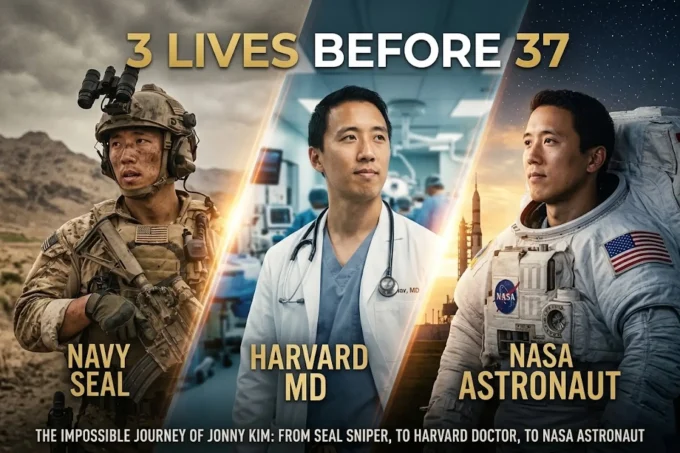
LOS ANGELES. The internet spent last weekend marveling at a man with three impossible careers. The man himself had already moved on. Lt. Cmdr. Jonny Kim, the Navy SEAL who became a Harvard-trained doctor and then a NASA astronaut, quietly left the space agency on August 27, 2026, after nearly a decade, and went back to the Navy to teach the next generation of naval aviators.
The rediscovery started with a single viral post. “Before turning 37, this man had already changed careers three times, going from a Navy SEAL sniper to a doctor and eventually a NASA astronaut,” the account @mymixtapez wrote on X on Sunday, October 11, alongside his photograph. The post drew more than 1,500 likes. The arithmetic checks out, and then some: Kim had all three careers locked down before his 37th birthday in February 2021.
His exit was no quiet footnote. “Jonny Kim represents the very best of NASA, a person who continually pushed the boundaries of exploration while inspiring countless others,” NASA Administrator Jared Isaacman said in the agency’s departure release. Johnson Space Center director Vanessa Wyche added that his “exceptional talent, determination, and grit will leave a lasting legacy at NASA.” Kim, 42, is spending his final military year with Training Air Wing 2, mentoring student pilots.
“Contributing to space exploration and serving NASA has been the honor of a lifetime,” Kim said in the same statement, released the day he walked out of Johnson Space Center for the last time. “Throughout my career, I’ve learned that beyond the missions, the training, and the hardware, success always comes down to the people. They are our greatest asset, and leading with love and empathy is how we achieve the impossible.”
The résumé behind that farewell began in pain: Kim is the son of South Korean immigrants who ran a liquor store in South Los Angeles, and his childhood was marked by domestic violence at the hands of his father. In February 2002, after her husband threatened the family with a gun, the standoff ended when police shot him dead in the family attic. Kim graduated from Santa Monica High School that spring and enlisted in the Navy as a seaman recruit, chasing structure and an exit from the trauma.
The Navy turned him into a weapon system. Kim graduated the Basic Underwater Demolition/SEAL course with Class 247 and landed in SEAL Team 3 as a Special Warfare Operator Hospital Corpsman. Across more than 100 combat operations in Ramadi in 2006, he worked as a combat medic, sniper, navigator and point man, earning the Silver Star for repeatedly exposing himself to enemy fire to rescue wounded Iraqi soldiers, plus a Bronze Star with Combat “V” for valor.
Ramadi also set his course. On August 2, 2006, insurgent gunfire struck two of his teammates: Marc Alan Lee, the first Navy SEAL killed in action in Iraq, and Ryan Job, who was blinded. Kim fought to keep Job alive under fire, and the limits of what a battlefield medic could do never left him. “Seeing my friends get wounded and killed was the turning point,” he later told the Annals of Emergency Medicine in a 2018 interview, describing a duty to live a life of service worthy of their sacrifice.
So he rebuilt himself a second time. The Navy sent him through the Seaman to Admiral commissioning program to the University of San Diego, where he finished a mathematics degree summa cum laude in 2012, and then to Harvard Medical School under the Navy Health Services Collegiate Program. He collected his Doctor of Medicine in 2016 and started an emergency medicine residency at Massachusetts General Hospital and Brigham and Women’s Hospital in Boston.
Boston added the third pivot. While working hospital shifts he met Scott Parazynski, a physician and former astronaut, who nudged him toward aerospace medicine. In June 2017, NASA picked Kim out of a record pool of more than 18,300 applicants for Astronaut Group 22, nicknamed “The Turtles.” Two and a half years of candidate training ended on January 10, 2020, when, at 35, he graduated as the first Korean American NASA astronaut, as CNN reported at the time. He also holds a rare dual designation as both naval flight surgeon and naval aviator, a distinction fewer than 80 officers have earned since World War I.
His one flight was a long one. Kim launched aboard Russia’s Soyuz MS-27 on April 8, 2025, with cosmonauts Sergey Ryzhikov and Alexey Zubritsky, and served as a flight engineer on Expeditions 72 and 73 aboard the International Space Station. “Thank you so much. It’s the dream of a lifetime and I’m honored to be here,” he said as he floated aboard. He logged exactly 244 days, 23 hours and 16 minutes in orbit, circling Earth 3,920 times and covering nearly 104 million miles before the crew landed on the Kazakh steppe on December 9, 2025. Aboard the station he saw nine spacecraft arrive and six depart, work he followed with tours as a Mission Control capsule communicator and contributions to the Artemis program.
Look at the sequence and a pattern shows through the trivia. Each career was launched by the limit of the one before it. Battlefield medicine ran out at the tourniquet, so he became a doctor; emergency rooms could not see the whole patient, so he reached for space, where medicine meets engineering at its most unforgiving. Nothing on the list came from wanderlust. It came from a running audit of what he could not yet do for people.
That is also why the ending fits. The man who kept leveling up is going out as a teacher of beginners, training student naval aviators the way corpsmen once trained him. It is a reminder of how far behind reality the viral internet runs: the feeds spent October 2026 celebrating an astronaut who had already hung up the title in August, a lag Space.com noted when the departure came. The frontier he kept chasing is still being documented from the station he lived on, in science ranging from an odd growth found aboard the ISS that Hypefresh covered to work closer to home like a paralyzed patient writing her name by thought.
Kim, a Pat Tillman Foundation scholar who shares three children with his wife, has never framed any of it as talent. “Going into the Navy was the best decision I ever made in my life,” he has said. “It completely transformed that scared boy who didn’t have any dreams to someone who started to believe in himself.”
For verification, readers can consult NASA’s departure release and his official NASA biography, the 2018 Annals of Emergency Medicine interview, NASA’s landing blog and his current NASA biography PDF, alongside the viral post embedded above.