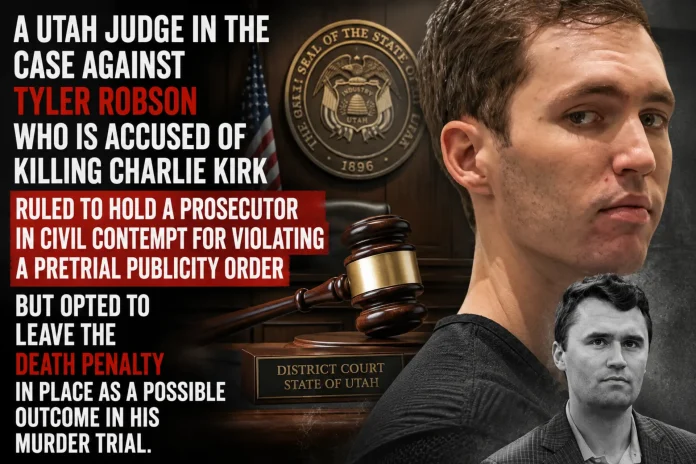
A Utah judge ruled on Friday that Deputy Utah County Attorney Christopher Ballard violated the court’s pretrial publicity order in the high-stakes murder case against Tyler Robinson, finding him in civil contempt for certain public statements about the strength of the prosecution’s evidence. Judge Tony Graf of the Fourth District Court rejected the defense’s request to remove the death penalty as punishment for the violation, calling such a sanction grossly disproportionate to the misconduct. Instead, the court ordered the state to cover the defense team’s attorney fees related to the motion while imposing measures to protect the integrity of the upcoming trial.
The ruling adds another layer of complexity to a case that has gripped national attention since September 10, 2025, when conservative activist and Turning Point USA co-founder Charlie Kirk was fatally shot in the neck during a public event at Utah Valley University in Orem. Robinson, a 23-year-old from southwestern Utah, faces aggravated murder charges, with prosecutors signaling their intent to seek capital punishment. The proceedings have drawn intense media scrutiny and competing narratives about the evidence, making enforcement of the gag order especially critical to ensuring Robinson receives a fair trial by an impartial jury.
Not long after Kirk’s assassination, Judge Graf issued a pretrial publicity order designed to limit out-of-court statements that could prejudice potential jurors or distort public understanding of the facts. Despite this restriction, Ballard engaged with media outlets multiple times in the months that followed. Robinson’s defense team specifically challenged comments Ballard made this spring regarding an ATF ballistics report on a bullet fragment recovered from Kirk’s autopsy. The defense had highlighted in court filings that the report could not conclusively match the fragment to a rifle authorities have linked to Robinson through DNA evidence found on the trigger and casings.
Ballard maintained that his communications were not violations but necessary efforts to “correct the record” after what prosecutors described as misleading characterizations by the defense. He argued that an “inconclusive” forensic result does not mean the evidence was excluded or that it exonerates the defendant. It simply indicates that examiners could not make a definitive determination based on the available markings and comparison data. Judge Graf appeared to accept this distinction in part, noting that a false public narrative claiming the murder weapon had been definitively ruled out created substantial undue prejudice against the prosecution’s case. The judge found that Ballard’s explanations of the forensic meaning of an inconclusive test were narrowly tailored and appropriate to counter that specific misinformation.
However, the court drew a clear line on a separate set of remarks. Judge Graf determined that Ballard crossed into prohibited territory with statements made to TMZ in which he discussed the overall strength of the state’s case against Robinson. Those comments, the judge ruled, went beyond correcting inaccuracies and instead implied Robinson’s guilt in a manner that violated the gag order’s core purpose. This distinction proved pivotal in the contempt finding, even as the judge preserved the death penalty as a possible outcome should Robinson be convicted.
The decision reflects the delicate balance courts must strike in politically charged capital cases where public interest runs extraordinarily high. Gag orders exist to safeguard the constitutional right to a fair trial by minimizing the risk that media coverage or attorney statements will taint the jury pool before evidence is properly presented in court. At the same time, prosecutors often feel pressure to respond when defense filings generate widespread speculation or conspiracy theories online and in traditional media. The case has already spawned bizarre conspiracy theories about Charlie Kirk’s death, illustrating how high-profile political assassinations can attract unfounded speculation. Judge Graf’s ruling acknowledges both realities while holding attorneys accountable for statements that cross the line into advocacy about a defendant’s culpability.
Legal observers note that this nuanced outcome sends a measured signal: courts will enforce publicity restrictions when necessary, yet they remain reluctant to impose remedies that fundamentally alter the prosecution’s charging decisions unless the misconduct is severe and directly tied to unfair prejudice. Prosecutors in the Charlie Kirk murder case were held in contempt for violating restrictions on public statements, though the death penalty remains on the table. The state will now pay the defense’s associated legal costs, a tangible but limited consequence compared with the defense’s original request. With the preliminary hearing scheduled for early July, both sides will continue preparing under heightened scrutiny as the case moves closer to trial.
For Robinson, the ruling means the most serious sentencing option remains available to prosecutors if he is convicted. For the broader justice system, it underscores the challenges of managing information in an era of instant digital dissemination, where even technical forensic details can quickly fuel competing narratives. The proceedings continue to test how American courts protect due process when a high-profile political assassination collides with relentless public and media interest. Other recent cases have shown similar dynamics, from chaos at Sean “Diddy” Combs’ trial as jurors lined up for seats to Lil Durk facing a judge in his own murder-for-hire case, demonstrating how celebrity and political trials strain courtroom protocols.
The Charlie Kirk assassination has also reverberated through conservative media circles, prompting figures like Steven Crowder to revive his “Change My Mind” campus debate series following Kirk’s death. Meanwhile, Elon Musk raised security concerns after Charlie Kirk murder claims surfaced online, showing how the killing has triggered broader conversations about safety for public figures in polarized times.