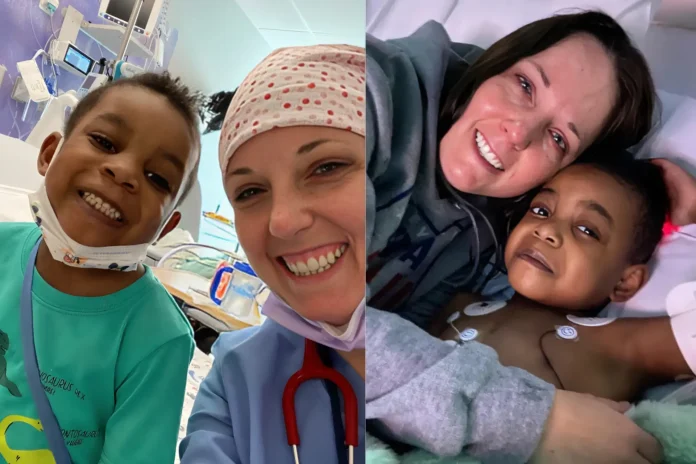
In January 2022, four-year-old True sat alone in a pre-op room at Children’s Nebraska in Omaha. Covers pulled to his chin, eyes wide with fear, the foster child waited for a heart catheterization. No parent or guardian was with him. His caseworker had COVID-19 and could not accompany him that day.
Dr. Amy Beethe, the pediatric cardiac anesthesiologist assigned to his case, later recalled the moment.
“He was sitting there all alone,”
she told KETV.
“It took me back that this 4-year-old was going to go through heart surgery, and nobody was there.”
She added in reporting by The Washington Post:
“I don’t really see kids by themselves in pre-op. You could tell he was scared and nervous, and didn’t know anyone.”
True had a condition right from birth where one side of his heart was underdeveloped. He had already gone through open heart surgery sometime in 2021 but had problems after that. The surgery done in January took about seven hours to complete. Beethe had been licensed as a foster parent in 2017 alongside her husband Ryan and couldn’t stop thinking about the undernourished boy in need of medical attention without any family.
She called his caseworker and learned placement had been difficult because of his complex needs. Within weeks, True moved in with the Beethes.
“We went up and met True in the hospital and immediately fell in love with him,”
Ryan Beethe said.
“It wasn’t long before we knew we needed him in our family.”
Amy later described the bond simply:
“He’s truly become my son. I would battle for him like anybody else. When it comes to his health, I’m a mama bear, and I fight hard.”
The couple adopted True and his biological sister Laney to keep them together. They also helped arrange permanent homes for his other four siblings through Amy’s sister, Ryan’s brother, and a fellow anesthesiologist at the hospital. All six children’s adoptions were finalized on the same day in August 2023.
“The six all found homes,”
Amy Beethe said.
“It’s a butterfly effect of kindness.”
True’s cardiologist, Dr. Jason Cole, has stressed the importance of a stable home environment for True’s care to continue successfully. Kids with complex conditions require consistent treatment and have been observed to benefit from stability in terms of preserving transplant opportunities if required at any point in time. True, living now with a blended family of eight, says,
“I like having a big family. I’m feeling good.”
Of Amy and Ryan, he says,
“They’re my mom and dad.”
In this instance, the reality of the needs of medically complex children in foster care is brought into focus and the importance of one stable family in meeting their medical and social needs. It was one doctor’s intervention that enabled True to stay together with his siblings.