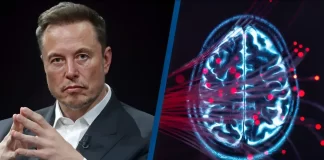
A woman paralyzed for two decades has done the unthinkable: she wrote her name again, using nothing but her thoughts, thanks to a Neuralink brain chip. Audrey Crews, who lost all movement at 16 after a devastating injury, pulled off this feat at the University of Miami Health Center. Surgeons there tucked a device the size of a quarter under her skull, laced with 128 hair-thin threads in her motor cortex. This chip lets her steer a computer cursor and tap out words on a keyboard with her mind, no hands needed. It’s the kind of breakthrough that stops you cold, a glimpse into how tech might hand back freedom to those trapped by paralysis.
Audrey’s story is raw and real. Now in her mid-30s, she’s lived half her life unable to scribble a note or hug a loved one. With Neuralink’s implant, she’s not just written her name; she’s got plans to run smart home devices, chat more freely, and write a book about her fight. The tech comes from Neuralink, the brainchild of Elon Musk since 2016. A surgical robot, dubbed R1, plants those tiny electrodes, linking the brain to computers wirelessly. Neuralink calls it “telepathy,” a system that turns thoughts into clicks, drags, and keystrokes, giving people like Audrey a voice again.
As of late July 2025, Neuralink has implanted nine people with its N1 chip, seven of them in the PRIME study at Barrow Neurological Institute in Phoenix. The PRIME trial, cleared by the FDA in May 2023, targets those with quadriplegia from spinal cord injuries or ALS. There’s Noland Arbaugh, the first to get the chip in January 2024, who now plays chess and scrolls the web. Another patient, Alex, got his in mid-2024 and uses it to game and design 3D models. Arbaugh had a hiccup when some threads shifted, messing with the signal, but Neuralink patched things up. On July 21, 2025, they did two implants in one day, showing they’re picking up speed.
Neuralink’s going global. Last November, Canada launched the CAN-PRIME trial, and on July 31, 2025, Great Britain kicked off GB-PRIME with University College London Hospitals and Newcastle Hospitals. The CONVOY study, also started in November 2024, is testing whether the chip can drive robotic arms, aiming to bring back physical control. Neuralink’s eyeing 20 implants by the end of 2025, with hopes of hundreds more soon.
The company’s dreaming big. They’re working on Blindsight, a chip to restore sight, even for those blind since birth. It’s got FDA Breakthrough status, with trials possibly starting in early 2026, maybe in the UAE. Blindsight would jolt the visual cortex to create basic, pixelated images, like retro video games. Musk’s even floated wild ideas like seeing infrared, but scientists say that’s a long shot. Neuralink also wants to tackle depression, autism, and schizophrenia, though those are still just talk.
It’s not all rosy. The brain’s a brutal place for tech, with its salty, shifting environment chewing up electrodes over time, as Neuralink noted in a 2024 post. Then there’s the backlash. Animal tests at UC Davis from 2017 to 2020 left monkeys with brain swelling and infections, prompting USDA investigations and heat from groups like the Physicians Committee for Responsible Medicine. Neuralink’s delay in registering its PRIME study until May 2024 raised eyebrows, though it’s now public. Critics fear the company’s breakneck pace could jeopardize patients.
Neuralink’s got rivals, too. Synchron’s device slides into blood vessels, skipping major surgery, and has already reached several patients. Blackrock Neurotech and Precision Neuroscience are in the mix, and a 2023 Swiss study got a paralyzed man walking with brain-spinal tech. Neuralink’s wireless design and high electrode count give it an edge, but experts like Duke’s Miguel Nicolelis argue it’s oversold and riskier than claimed.
Audrey Crews’ story cuts through the noise. Writing her name isn’t just a tech demo; it’s a woman reclaiming her spark. Neuralink’s got a long road ahead, proving its tech is safe and scaling it up. But for now, Audrey’s victory shows what’s possible when stubborn hope meets cutting-edge science.