

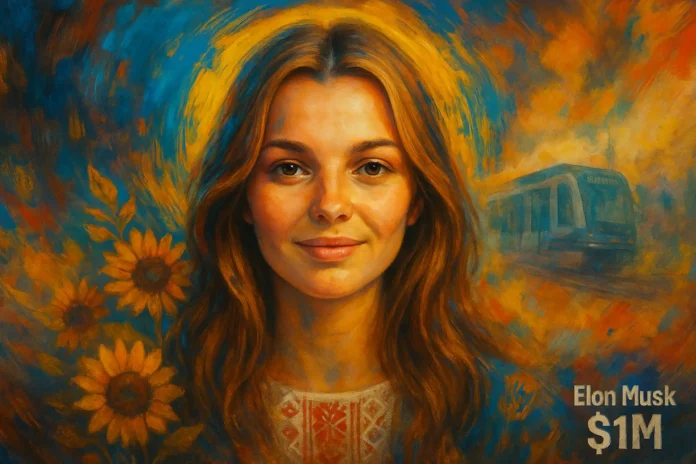
The tech billionaire joins a growing movement to honor the 23-year-old Ukrainian refugee fatally stabbed on a Charlotte train.
Iryna Zarutska was only 23 when her own route toward a new life was terminated in a violent manner. A refugee who had fled Ukraine in 2022 when Russia initially invaded, she had traveled to North Carolina in search of safety, belonging, and a future.
A tweet from X.
Friends call her artistic, kind, and forward-thinking. She worked shifts at a neighborhood pizzeria in Charlotte while in school at Rowan-Cabarrus Community College, where she aspired to be a veterinary technician.
“She just wanted to help animals and plan for the future,”
A classmate told the Charlotte Observer.
Those dreams were shattered on August 22, 2025, when Zarutska was fatally shot on a late-evening light rail train on Charlotte’s Blue Line. The killing has stunned her family and surrounding neighborhood but also sparked a national conversation on violence, mental health, and safety in America’s communities.
Zarutska’s move to the U.S. was a new beginning. She was described by the family as a Ukrainian in spirit but a fully embracing adoptive country home dweller. She enjoyed painting, having pets for company, and a distinctive immediate laugh.
“She survived war only to be taken from us like this. It doesn’t feel real.”
,” her cousin told reporters. “
Surveillance footage from the Charlotte Area Transit System shows 34-year-old Decarlos Dejuan Brown Jr. seated behind Zarutska before lunging at her with a pocketknife, stabbing her multiple times in the neck. Passengers screamed and rushed to safety, but Zarutska collapsed and later died of her wounds.
Brown was arrested at the scene. Court records show he had a long history of criminal charges, including armed robbery, and had been diagnosed with schizophrenia earlier this year. His mother had sought involuntary psychiatric commitment after violent behavior, but he was released without bail after a separate arrest.
Federal prosecutors have charged him on a count of “Terrorist Attack or Other Violence Against a Mass Transportation System” a rare crime with a possible death penalty.
In court, Brown spoke in disjointed fragments.
“So you said something in your body did what? Nah, uh, the material, uh, I feel like the material using my body to stab a lady,”
He told investigators. His statements have fueled debate about untreated mental illness and gaps in the justice system.
Amid the outpouring of grief, a surprising source stepped forward. On September 10, 2025, Elon Musk replied to a fundraising campaign on X, writing:
“I will contribute $1M.”
The campaign had been launched just a day earlier by Intercom CEO Eoghan McCabe, who committed $500,000 in $10,000 grants to artists willing to create murals of Zarutska in prominent U.S. cities. Musk’s pledge instantly doubled the scale of the project.
The plan calls for murals in New York, Los Angeles, Chicago, and Charlotte, with artists across the country invited to submit proposals.
“We will install as many posters and murals across this great nation as funds afford so that the important conversations her slaying provokes may perpetuate and drive much needed change,”
McCabe said.
The attack has reignited fierce debate in the U.S. about public safety and systemic failures.
President Donald Trump called Brown “a madman” and urged prosecutors to pursue the death penalty. Others focused on transit security, noting the absence of security personnel in the train car during the attack.
Mental health advocates argue that Brown’s release from psychiatric evaluation earlier this year highlights the country’s ongoing crisis.
“This was preventable. The system failed both him and his victim.”
Said one Charlotte-based psychiatrist.
On social media, reactions have ranged from mourning Zarutska’s loss to skepticism over Musk’s pledge. Critics have noted Musk’s past philanthropic controversies, while supporters praised him for amplifying Zarutska’s story.
The mural campaign is more than memorial it’s an effort to transform grief into dialogue. Advocates point to parallels with murals created after George Floyd’s death in 2020, which turned city walls into canvases of remembrance and protest.
“Public art can keep a victim’s story alive. It’s not just paint on a wall. It’s a statement that we will not forget.”
Said a community arts organizer in Los Angeles.
Already, more than 800 artists have expressed interest in joining the project.
Organizers say the first murals could appear within weeks, though details about locations and permits are still being finalized. Fundraisers on GiveSendGo and GoFundMe continue to collect money both for Zarutska’s family and for the mural project.
For Zarutska’s loved ones, the murals will not bring her back. But they may ensure that her face, her story, and her dreams are remembered not just in Charlotte, but across the United States.
As one friend wrote online
“She left Ukraine for safety. Now she will live forever in art.”

