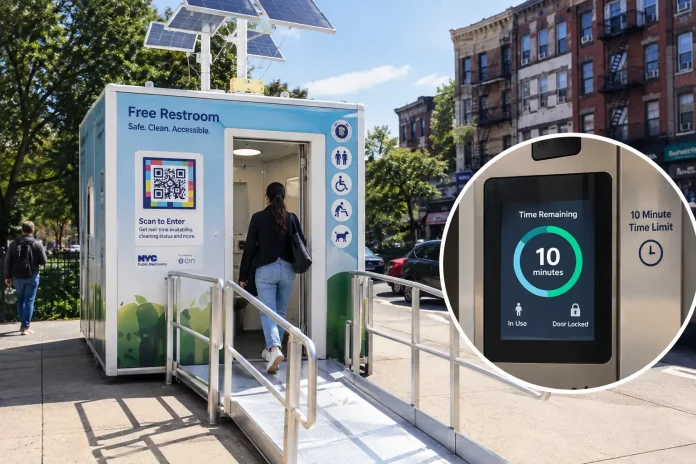
New York City has begun installing 17 free modular public bathrooms across all five boroughs as part of a $4 million one-year pilot program, Mayor Zohran Mamdani announced on September 16, 2026. The high-tech units, built and operated by Throne Labs, feature a hard 10-minute time limit: users receive audio warnings at five and eight minutes, flashing lights at the 10-minute mark, and an automated announcement before the door slides open about 30 seconds later.
“This is not a place to scroll on your phone,” Mamdani said at a press conference held at Throne Labs’ warehouse in Long Island City, Queens. He framed the initiative as a practical response to the city’s long-standing shortage of public restrooms, noting that New York currently has roughly one public bathroom for every 8,000 to 8,500 residents—far fewer than many peer cities.
The self-contained units do not require connections to the city’s water, sewer, or power infrastructure, allowing them to be deployed, relocated, or removed more quickly and cheaply than traditional restrooms. They are ADA-accessible, fully touchless, climate-controlled (with heat and air conditioning), and equipped with a flushing toilet, running-water sink, baby-changing station, and free menstrual products. Some feature plant-themed or tropical wallpaper. The bathrooms operate daily from 7 a.m. to 10 p.m.
Access requires one of four methods: scanning a QR code, sending a text message, using the Throne Bathroom Network app (which also shows real-time availability and cleanliness ratings), or tapping a free physical card distributed by local community partners. Signs at each unit direct people without smartphones to nearby card distribution points within a roughly 10-minute walk.
How the Timer Works
Users are informed of the 10-minute limit upon entry. At five minutes, background music stops and a reminder plays. At eight minutes, a second warning urges them to wrap up. At 10 minutes, lights flash and an announcement in English and Spanish states that time has expired and the door is opening. Officials emphasize a short grace period of about 30 seconds so the door does not open while someone is still mid-process. If an occupant remains after the door opens, Throne Labs staff receive an alert and can respond; police may be called in extreme cases. The company says the average visit in other cities lasts about 3.5 minutes, and the limit is intended to deter loitering, drug use, and other prolonged occupations while also allowing visibility during medical emergencies.
Throne Labs, which already operates similar networks in Washington, D.C., Los Angeles, Atlanta, Seattle, the Bay Area, and Detroit, is responsible for cleaning and maintenance. Units are typically cleaned by staff every 11 to 15 uses, guided by sensors and real-time user ratings.
Locations
The 17 sites are:
- Bronx: Yankee Stadium, Admiral Farragut Playground, Mapes Park, Monsignor Raul Del Valle Square
- Brooklyn: Columbus Park, Milestone Park, Fulton Street and Truxton Street, Avenue C Plaza
- Queens: Astoria Boulevard South and 31st Street, Northern Boulevard and 31st Street, Northern Boulevard and 54th Street, 34th Avenue and 64th Street
- Manhattan: Cooper Square, Malcolm X Plaza, Delancey Street and Suffolk Street, Plaza Alianza Dominicana
- Staten Island: North Shore Esplanade
The first units began operating in mid-September, with the remainder expected online in the coming months.
Reactions and Concerns
Advocacy groups including the Free to Pee Coalition, VOCAL-NY, and the Coalition for the Homeless welcomed the added facilities but raised concerns that phone- or card-based entry could create barriers for some homeless New Yorkers. City and company officials point to the free card distribution network as a solution. Critics have also noted that the 10-minute limit may be insufficient for people with mobility challenges, medical conditions, or caregiving responsibilities; Throne Labs has said it is developing options for extended access in those cases.
The pilot is a relatively small step toward the City Council’s longer-term goal of more than 2,100 public restrooms by 2035. Officials say results from the year-long trial will help determine whether and how to expand the modular model citywide.