

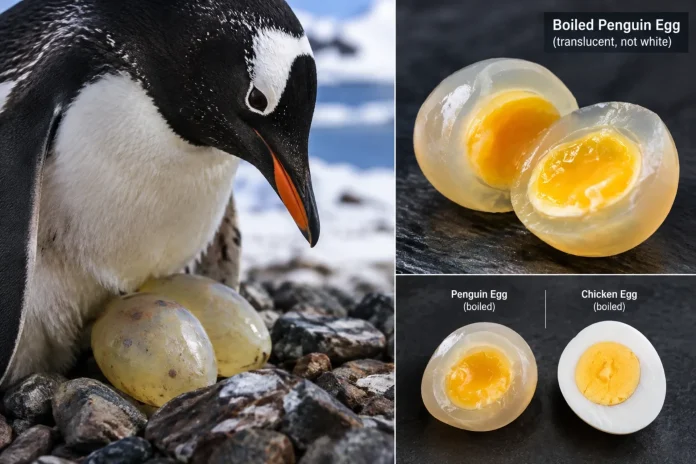
There’s something seriously strange about a boiled penguin egg.
Boiled penguin eggs can look almost nothing like the chicken eggs most people know. Instead of turning opaque white, the albumen can remain translucent and jelly-like, allowing the bright yolk to remain visible.
The unusual appearance comes down to the proteins inside the egg white.
Chicken egg whites are made up largely of ovalbumin. When heated, these proteins unfold and form a dense network that traps water and scatters light. That’s what gives a hard-boiled chicken egg its familiar solid-white appearance.
Penguin eggs have a very different protein composition. Their albumen contains unusually high levels of penalbumin, or PEN, a glycoprotein found in much smaller amounts in chicken eggs.
When heated, the proteins in penguin albumen still denature and the white sets, but the resulting structure can remain softer and more translucent. Because it scatters less light than the protein network in a chicken egg, the yolk can remain clearly visible through the cooked white.
The result is an egg that looks almost like a bright yolk suspended inside clear jelly.
The effect isn’t simply caused by undercooking or egg freshness. It’s linked to the biological differences between penguin and chicken albumen, particularly their different protein compositions.
Penguin eggs have been eaten historically in parts of the Antarctic and Falkland Islands, with Gentoo penguin eggs appearing in historical food accounts. However, modern wildlife protections restrict or prohibit collecting penguin eggs in many regions.
The strange appearance ultimately comes down to chemistry. Chicken egg whites form an opaque, light-scattering gel when heated, while penguin albumen can form a more translucent structure. That’s why a boiled penguin egg can remain see-through enough for its yolk to be visible inside.

