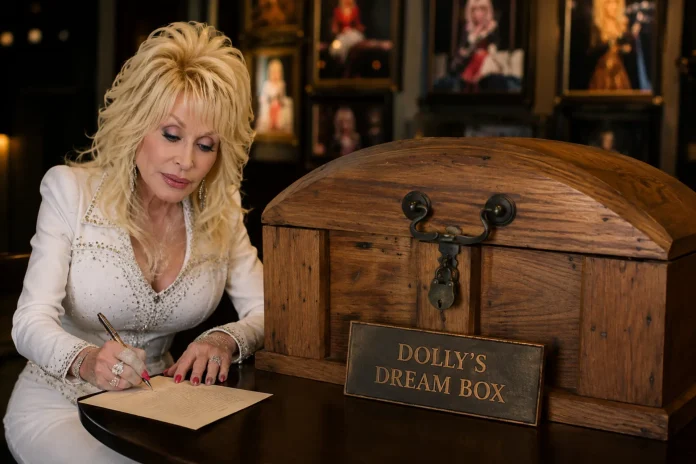
The chestnut box sits behind a velvet rope in the lower-level lobby of the DreamMore Resort, the same place it has sat for nearly a decade. Nobody knows what is on the disc inside, and nobody will until January 19, 2046, the day Dolly Parton would have turned 100. Her death on August 25 at age 80, after a brief battle with cancer at the Vanderbilt-Ingram Cancer Center in Nashville, did nothing to change that arrangement. If anything, it sealed it tighter.
The “Dream Box” story is the one that ran in the obituaries. So is the moment her nephew Bryan Seaver, who served as her head of security for more than twenty years, stepped in front of a camera to deliver the news she had asked him to deliver years before. So is Marcel Pariseau’s short statement about her passing — confirmed by AP News. The world knows the songs. Jolene. Coat of Many Colors. I Will Always Love You. The thing the obituaries are quieter about is the hospital where she died, and what she had quietly been doing there for years.
In April 2020, as the country shut down and the Moderna mRNA vaccine was still an idea sketched on a lab whiteboard, Parton wired one million dollars to Vanderbilt University Medical Center — a gift confirmed by the hospital. Her name appears in the preliminary report on the Moderna vaccine alongside the National Institutes of Health. That gift, and the research it helped fund, became part of the scientific foundation that helped pull the world out of the pandemic. Six years later, she died of cancer in the same building.
This is not a metaphor. It is a fact, and it is the fact that is going to age the strangest.
Vanderbilt-Ingram Cancer Center is where Parton spent her last hours, surrounded by family. It is also where, in 2017, she gave another million dollars to the children’s hospital’s pediatric cancer program in honor of a niece who had been successfully treated for leukemia there. It is where she sent a second million in 2022 for pediatric infectious disease research. And it is where, earlier this year, she pledged every net dollar from a re-release of her 1977 song “Light of a Clear Blue Morning” to pediatric cancer research, because she said she wanted the song to keep doing some good in the world.
She told People magazine in an interview published four days before her death that she had been dealing with some health issues she had put off while caring for her husband, Carl Thomas Dean, who died in March 2025 at the age of 82. She did not say what the issues were — a silence shared by other public figures who died of cancer recently. The interview did not name Vanderbilt. She kept her appointments, missed an opening at her own park, told fans that her Nashville doctor had “clipped my wings” and that she was not traveling this week. That was the last most people heard from her.
The Vanderbilt donations were not flashy. Parton never made a press conference of any of them. The April 2020 gift made news because it was the middle of a lockdown and she happened to mention it during a televised appearance. The pediatric cancer money in 2017 was a check and a hand-written note. The Light of a Clear Blue Morning pledge showed up in a foundation filing, not a press release. If you wanted to find the total, you had to add it up yourself.
The reality is more ordinary than that, and more interesting. Over the years, she gave to the hospital where her niece had been treated for leukemia in 2017, to the same hospital’s pediatric infectious disease research in 2022, and to a fund for families burned out of their homes after the 2016 Gatlinburg wildfires. She gave to the hospital where she was dying. That is not a philosophy. That is a habit.
Her friend Robert Oermann, who co-wrote her 2020 book Dolly Parton, Songteller (one of several major songwriter deaths that marked this year): My Life in Lyrics, told CNN through tears that she was a “steadfast champion” of working people and that her “isolated mountain upbringing” shaped her sense of obligation. Growing up the fourth of twelve children in a two-room cabin in the Great Smoky Mountains without running water or electricity, in a family where her own father could not read, gave her, in Oermann’s words, “that sense of humanity.” She started the Imagination Library in 1995 because of that father — and kids still aren’t reading the way she hoped. She gave to pediatric cancer research because of that niece. She gave to infectious disease research because her community had been hit, and then because the world had been hit.
It is easy, writing about someone the morning after they die, to reach for the bigger numbers. One hundred million records sold. Fifty albums. Twenty-five number-one hits. A Broadway musical that will open on January 19, 2027, what would have been her eighty-first birthday, at the St. James Theatre. The Imagination Library has now mailed more than three hundred million books to live, free of charge, all because a Smoky Mountain girl whose father could not read wanted to fix that one thing for the next generation.
None of those numbers are the story. They are the scaffolding around it. The story is that on the same day that Parton was being admitted to Vanderbilt-Ingram for the last time, somewhere in the building her 2020 dollar was still doing its work, in the form of research projects that grew out of the Moderna collaboration. She had given that money to keep people alive. The hospital she gave it to is where her own life ended. There is no clean way to write that sentence, and no reason to clean it up.
The Dream Box stays closed. The song she wrote for it, “My Place in History,” remains unheard. She sealed the box in 2015 when the resort opened, with a CD player inside so the track could still play decades later, along with a piece of wood from the front porch of her childhood home, where her family had gathered and where she had sung as a girl. She told Kelly Clarkson in 2022 that the secrecy burned her up inside, that she wanted to dig it up and use the song, because, as she said, “it’s a really good song.” She would not.
She made her last public appearance, in spirit if not in body, in the form of that Light of a Clear Blue Morning pledge. She made it earlier this year. It will continue. The hospital where she died will keep doing what hospitals do, partly because of what she gave it, partly because of what she had already given it years earlier. Twenty years from now, on the morning of January 19, 2046, somebody will open the chestnut box at the DreamMore Resort and a recording of a song nobody has heard will play for the first time. The woman who wrote it, and sealed it, and gave the song away to the future, will have been gone for nineteen and a half years by then. The hospital she kept giving to will still be there.