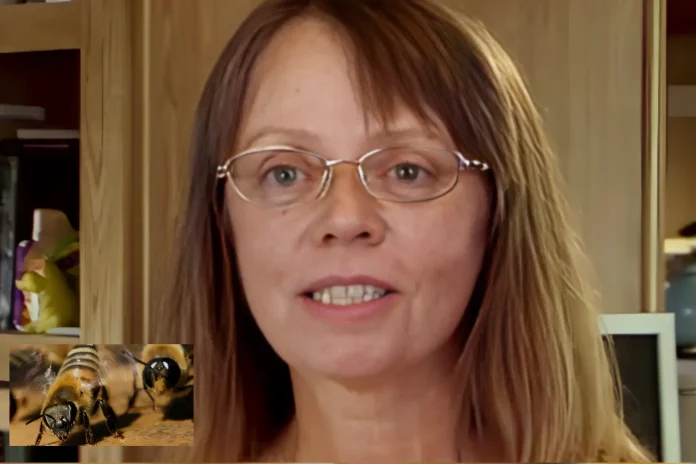
Margaret, a 53-year-old from Morningview, Kentucky, told cameras she had deliberately stung herself more than 50,000 times. She kept live bees in her handbag so she could do it on the go.
The story first aired on TLC’s My Strange Addiction on February 20, 2013, in the episode “Extreme Hair / Addicted to Bee Stings.” In the footage, Margaret is blunt:
“My name is Margaret and I’m 53 years old. I live in Morning View, Kentucky, and I’m addicted to stinging myself with bees.”
She explained that she had started it around ten years ago as a way to alleviate her joint pains from arthritis. From reading about bee venom and its ability to cure joint pain, she decided to bring a bee home and get herself stung by it.
“When I first tried getting myself stung, it wasn’t as painful as I imagined,”
She said.
“Every time after that, it just became easier.”
The next day she said that she could move more easily than before.
By the time of filming, Margaret estimated she was taking up to 15 stings a day sometimes 100 in a week. Favorite spots included her hips (as many as 15 to 20 on the left hip at once), elbows, fingers, ankles, forehead, and the tip of her nose. She kept backyard hives for supply and carried bees in her purse. Using tweezers, she would press a bee’s abdomen against her skin until the stinger went in. She described the feeling as a “peppery burn” that somehow felt good. Without regular stings she said she grew irritable and anxious. She also told her husband, J.D., that after at least 10 stings “the sex is great.” He agreed on camera.
J.D. worried once the count hit 15 a day.
“She’s always had a kind of a taste for looking at the odd side of things,”
He said.
“At this point now, with 15 stings a day, that’s when I’m certainly getting really concerned about this.”
Doctor Dain Wahl examined her and issued a clear warning: repeated exposure could trigger a sudden, life-threatening allergic reaction even if previous stings had been tolerated.
“With bee stings, we’re not sure of how much of a dose is toxic,”
He said.
“So my biggest fear is that one day suddenly she’ll swell up, her throat will close and she’ll die. Would I recommend that she stops? Yes I would.”
Margaret agreed to cut back but said she had no plans to quit.
There are certain components of bee venom that are somewhat anti-inflammatory for osteoarthritis and rheumatoid arthritis patients based on some laboratory and clinical studies, yet there is insufficient evidence of the efficacy of this treatment. The potential dangers of live bee stinging are allergic reactions (anaphylaxis), infection, and venom toxicity. Having already been accustomed to being stung does not mean that one will be immune to such dangers in the future. Self-treatment with live bee stings is not a medically proven procedure.
Margaret’s case is a controversial example of how alternative therapy, psychological issues, and actual threat to life intersect. Personal comfort does not cancel the risk of a sudden allergic reaction. Since then, no news about Margaret have appeared in any media source. It is safe to say that self-stingings with live bees pose a threat and must be avoided in all circumstances.