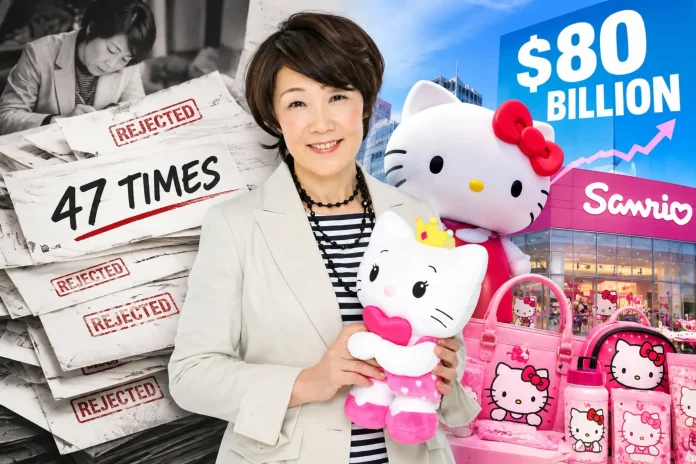
In the mid-1970s, a young illustrator at a Japanese gift company sat down with a brush pen and ink and drew a simple white cat-like figure with a red bow and no mouth. According to a story that’s been passed around for years, that sketch was turned down 47 times before anyone said yes. Whether the exact number is precise or part of the lore, the larger point holds: the design that would become Hello Kitty faced real skepticism inside Sanrio before it ever reached a store shelf. Today the character sits at the center of an estimated $80 billion-plus empire, ranking among the highest-grossing entertainment properties of all time.
Yuko Shimizu joined Sanrio after studying at Musashino Art University. The company, which had found early success with strawberry-print rubber sandals, was pushing its young designers to create original “kawaii” characters for everyday merchandise. Shimizu had already contributed earlier designs, including the bear Coro Chan. In 1974 she turned to a childhood memory — a white kitten her father had given her as a birthday gift — and quickly produced the figure that would later be named Kitty.
The drawing was deliberately understated: large head, yellow nose, whiskers, a red bow, and a blank expression so viewers could project their own feelings onto it. Early versions leaned into a side profile after an assistant told Shimizu that angle looked cuter. Executives were not immediately sold. The character struck some as too plain and too childish, lacking the strong personality or detailed story that seemed necessary for a commercial hit. Rather than rolling it out across a full product line, Sanrio tested the waters with a small clear vinyl coin purse in 1975, placing the design alongside several other new characters. Hello Kitty outsold them all and quickly became the company’s fastest-moving item. That early commercial proof opened the door.
Shimizu left Sanrio in 1976 to start a family. Because the work was done as a staff designer, she did not walk away with the kind of personal fortune the character later generated. She continued as a freelancer and later created other figures, including Angel Cat Sugar and Rebecca Bonbon. The visual direction of Hello Kitty eventually passed to other designers, most notably Yuko Yamaguchi, who spent more than four decades expanding the character’s world while keeping the core look intact.
What followed was a master class in licensing. Hello Kitty appeared on more than 50,000 products across more than 130 countries — stationery, fashion, jewelry, airplanes, musical instruments, and high-end collaborations. Cumulative revenue estimates commonly land between $80 billion and $84.5 billion, placing the franchise in rare company with properties like Pokémon and major Disney icons. The business model was never primarily about movies or television; it was about putting the character on the things people actually use and wear every day.
The viral version of the story likes to lean hard on the idea of 47 straight rejections. Documented accounts describe initial internal hesitation more than a formal string of that many turn-downs. Still, the arc is familiar to anyone who’s watched an idea struggle for oxygen before finding its moment. A modest sketch, a cautious test, a breakout product, and then decades of smart expansion turned a quiet design into a global brand that still moves product and culture half a century later.
In an industry that often chases the next big splash, Hello Kitty remains a reminder that sometimes the simplest ideas — the ones that almost didn’t make it out of the room — end up lasting the longest.