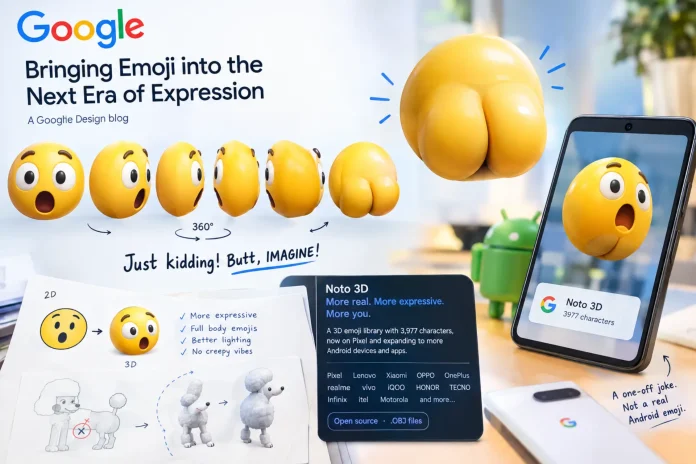
But here’s proof of what can go wrong when a well-recognized emoji is turned around with it’s two buttocks.
A Google Design blog entitled ‘Bringing Emoji into the Next Era of Expression’ used a row of spinning shocked-face emojis to show a serious problem encountered in the transformation of simple icons to three dimensional objects. At the end of the spin, the emoji face reveals cheeky buttocks on the back of its head. The caption underneath being
“Just kidding! Butt, IMAGINE!”
The joke is intentional and clearly labeled. Designers were making a point about the shift from 2D to 3D.
“In 2D illustration, you only have to solve for a single vantage point,”
The team wrote.
“In 3D, there’s nowhere to hide. Once we started imagining the 360-degree view of our assets, we started confronting questions Unicode never warned us about: What does the back of a smiley face look like?”
That one light-hearted image has been fueling all the attention recently, thanks to Dexerto covering it on October 9. Social media with help from Google Spain was responsible for spreading the joke. However, the butt does not feature in the official emoji set released on phones.
Behind the jokes, there is a serious story. Noto 3D is the result of the company’s efforts to revise Google’s emoji library, now containing 3977 characters in the form of true three-dimensional images. The purpose was to make them more meaningful and less creepy. All this was due to extensive user research that led to the development of these emoticons. For example, users have found that it is easier to understand the emotional expression of another person if they are presented in a simplified way. Moreover, it appeared that full-body emojis are more attractive than just a head, and that it is easier to get lost in a conversation if there are too many details.
The transition to three dimensions helped to fix some of the old problems. For example, the poodle’s tail had only three legs in the previous version because the fourth one was tucked in the original two-dimensional illustration. Google designers also managed to fix the uneven lighting by using an AI-powered contrast enhancer followed by a manual rim light to ensure sufficient contrast in dark mode, so that users do not have to guess what shade of skin color they are looking at.
Noto 3D first appeared on Pixel 11 devices and is expanding to other Android phones and Google apps. Partners already named include Nothing, Lenovo, Xiaomi, OPPO, OnePlus, realme, vivo, iQOO, HONOR, TECNO, Infinix, itel, and Motorola. The full set of 3D models is open source, available as .OBJ files for anyone who wants to remix them into apps, virtual spaces, or memes.
The viral image is genuine. Google really did publish it. Claims that the company is adding a permanent butt-backed emoji to Android are not. The design was a one-off joke to humanize a genuine technical challenge: when every side of a character suddenly exists, someone has to decide what it looks like.
Given all the time that it spends getting the right look on-screen for a wink or a wilting flower, the fact that the corporation can see the ridiculousness of the process makes its rebrand just as impressive.