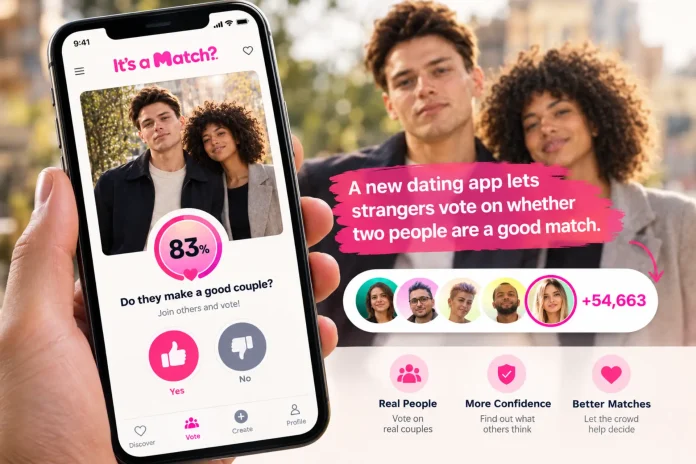
NEW YORK, NY – A former Tinder executive has launched Rivet, a dating network that lets strangers vote on whether two users would make a good couple. The app opened nationwide across the United States on Thursday, Sept. 24, 2026, backed by $10.5 million in seed funding, according to the company’s launch announcement on PR Newswire.
Rivet, founded by Taru Kapoor, is built around a model the company calls Social Matching. Potential pairs are first generated from users’ stated preferences, interests, relationship intentions and other profile details. Matchmakers, meaning other users, invited friends or higher-performing participants known as Elite Matchers, then review anonymized information about the two people’s personalities and goals, along with an AI-generated image of the pair together, before casting a vote.
Each vote registers as a pink heart for yes or a silver X for no, the New York Post reported. The review cards show personality traits, relationship intentions, interests and physical preferences, but no names.
Votes contribute to a Social Matching score shown to the daters as a percentage. High-scoring pairs receive an introduction, and each person then independently reviews the full profile and decides whether to match and start a conversation. Voting remains anonymous to the daters, according to the app’s help center.
The concept drew attention on social media within days of the launch.
The post from esports and culture outlet Dexerto, published Tuesday, Oct. 6, has drawn 297 likes, according to the post’s syndication data.
“Dating has always been social,”
Kapoor said in the statement.
“I spent many years thinking what we were building was removing friction from meeting people. Instead, we removed the people. Online dating apps created millions of connections in the last decade, mostly because they expanded the pool, connecting people to those they wouldn’t have met otherwise. A huge side effect of that was that they turned something as fundamentally social and human as dating into a lonely, overwhelming activity which felt transactional and isolating.”
“I built Rivet to change that,”
she continued.
“Rivet is built on a simple truth: humans understand chemistry and compatibility in a way that no algorithm can. You don’t have to find your person entirely on your own, let people help you find your person.”
Kapoor spent nearly a decade at Tinder and Match Group. She joined in August 2015 as general manager to launch Tinder in India, later expanding her role across South Asia, Southeast Asia and Turkey before leaving in September 2023. She founded Rivet in 2025 with Rajat Sahni, who previously led the used-car business at CarDekho, and the company operates as MeantToBe Inc. from New York while running its engineering and machine learning teams largely out of an office in Delhi NCR, India.
Anyone can join solely as a Matcher, including people who are married, in relationships or not looking to date. Matchers earn in-app Karma for voting and for successful pairings, and the currency can unlock premium features or, for users who meet the eligibility thresholds in the company’s Creator Program Policy, be redeemed for cash or gift cards. A Matcher Quotient score rated from 1 to 999 tracks thoughtfulness and alignment with eventual dater decisions, while daily soft and hard caps limit how many pairs one person can judge each day.
The seed round drew backing from Peak XV Partners, Shine Capital and Blume Ventures. Former Tinder and OkCupid CEO Elie Seidman is an early investor and advised Kapoor throughout development.
“The swipe was one of the defining product innovations in online dating because it changed the fundamental way people discovered each other,”
Seidman said.
“For the first time since the swipe, the category has something genuinely new: human judgment and a real social community built on the foundation of state-of-the-art technology, working at scale. That is what turns a dating app into a dating network, and it is a powerful, category defining shift.”
The company’s own counters told a more modest story alongside the national pitch. Rivet’s homepage listed 54,663 users and 27 matched pairs on Tuesday, figures the site attributes to its running totals, and its help center still tells some visitors the app “is currently only available in select areas as we gradually roll out.” The gap between a nationwide announcement and a staged rollout leaves open questions about how many Americans can actually open the app today.
Before the national rollout, Rivet tested the model in Charlotte, North Carolina, where Kapoor said in June that the app had drawn thousands of users. The company also staged live Socially Matched dating events in which audiences vote on which on-stage couples belong together, with free drinks for the room unlocked when attendees download the app.
The money side has drawn its own scrutiny. An analysis on the investment platform ainvest argued that Rivet effectively pays the crowd to be its algorithm, since users who want to message before a community match buy Karma packs that help fund the cash rewards. That structure means costs rise with every successful pairing, the analysis noted, inverting the high-margin economics of algorithmic incumbents and testing whether dating is a code business or a people business.
The launch lands as mainstream dating platforms hunt for a new hook. Tinder has been testing eye-scan “proof of humanity” badges to combat AI-generated profiles, while Hinge’s founder launched an AI dating app with no swiping or profiles. Even celebrity culture keeps circling the format, from KSI opening up about meeting his girlfriend on Tinder to the broader wave of stars discussing how they met their partners online.
Rivet is free to download on iOS and Android, though some features sit behind a paywall, including the ability to message someone before the community has matched the pair, the Straits Times reported. Algorithms and AI handle the pairing suggestions and the composite images, while the core compatibility judgment stays with people. The stated goal is fewer, higher-quality introductions instead of endless swiping.
A company-commissioned national survey of 2,013 U.S. adults found that 68 percent of Gen Z and Millennial respondents said they would be interested in anonymously helping someone they do not know find a potential match if the other person retained the final decision. The figure included 78 percent of Gen Z respondents and 60 percent of Millennials.
More information is available at rivetdating.com.