

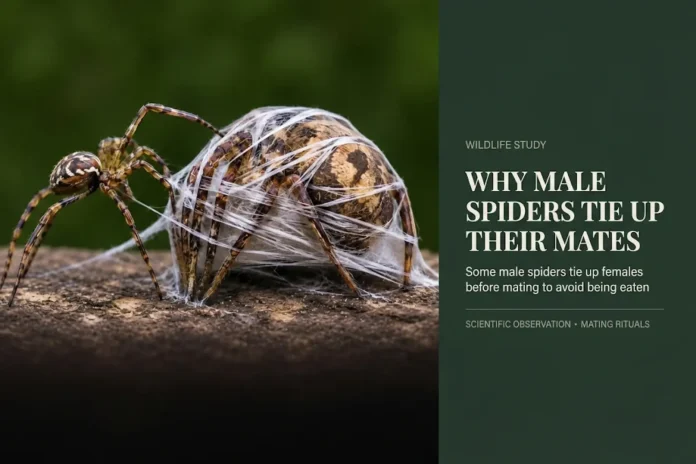
Male spiders in several species restrain females with silk before and during mating, a tactic that dramatically improves their odds of surviving the encounter instead of becoming a meal.
In the nursery-web spider Pisaurina mira, common across eastern North America, males use their elongated front legs and spinnerets to wrap the female’s forelegs in silk. Researchers at the University of Nebraska-Lincoln tested the behavior in 2016 by blocking the silk-producing organs of some males with dental silicone. Only about 10 percent of the restrained males survived mating, compared with roughly 70 percent of those able to bind their partners. The silk-wrapping males also achieved more sperm transfers, increasing their chances of fathering offspring.
Alissa Anderson, then a doctoral student working with biologist Eileen Hebets, observed that receptive females often curl their legs in a way that makes wrapping easier. Once the male inserts his pedipalps, however, females typically begin struggling to free themselves. The brief window created by the silk gives the male time to escape while she works free.
A different approach appears in the running crab spider Thanatus fabricii, studied by Lenka Sentenská and colleagues. These spiders, collected in Israel’s Negev Desert and observed in the lab, skip elaborate courtship. The male rushes the slightly larger female and bites her legs several times. The bites trigger a temporary immobility response in which the female pulls in her legs and remains still. The male then quickly lays silk over her body and legs before mating, which lasts about 19 minutes on average.
“Spiders sometimes spend hours luring females to court them, but these guys just go and bite,” Sentenská told New Scientist. Some males were eaten before they could deliver the first bite. Females can break free with a few sharp jerks, and researchers suspect chemical signals in the silk may influence how long she remains cooperative.
The binding behavior, sometimes called a bridal veil, has been recorded in at least 30 spider species across multiple families. In most cases it appears to reduce the risk of sexual cannibalism, a well-documented phenomenon in which females consume males before, during or after mating. Females are often larger and stronger, and a protein-rich meal can improve egg production or offspring quality. In nursery-web spiders, later work by Anderson and Hebets showed that females who ate their mates produced heavier, longer-lived young than those given equivalent non-mate prey or nothing at all.
Males of other species have evolved different escape strategies. Some offer nuptial gifts of wrapped prey. Others catapult themselves away at high speed after mating, as documented in the orb-weaver Philoponella prominens. A few species even mate with recently molted females whose soft bodies make cannibalism temporarily impossible.
In Thanatus fabricii, the coercive style carries a cost for females. After mating, they showed reduced mobility and lower success catching ants, their preferred prey. The finding suggests the male’s strategy may harm female fitness even when she survives the encounter unharmed.
Researchers continue to examine whether silk itself carries pheromones that calm females or signal male quality, and how often these behaviors occur in the wild versus the laboratory. What is clear is that in a world where mating can mean death, some male spiders have turned silk into both a tool of restraint and a ticket to survival.

