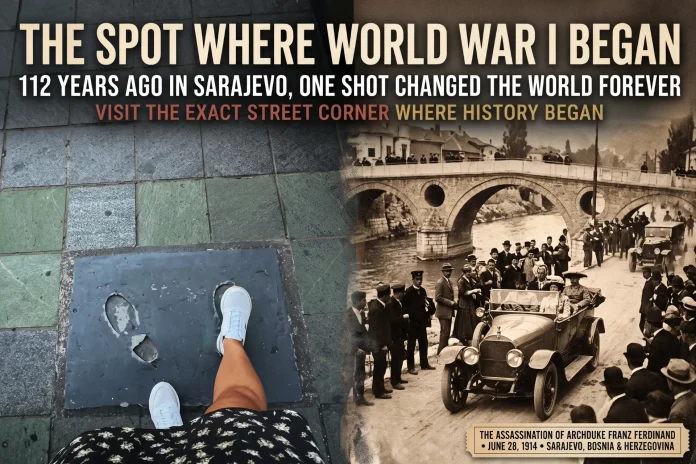
SARAJEVO, Bosnia and Herzegovina On a quiet street corner at the north end of the Latin Bridge, a small grey plaque marks the exact spot where the First World War began. “From this place on 28 June 1914 Gavrilo Princip assassinated the heir to the Austro-Hungarian throne Franz Ferdinand and his wife Sofia,” it reads, in Bosnian and English, and anyone can still walk up and read it for free.
The corner sits at the junction of Zelenih beretki and Obala Kulina bana, beside the Miljacka River in central Sarajevo. In 1914 the ground floor of the building was Moritz Schiller’s delicatessen. Today it houses the Museum of Sarajevo 1878-1918, a small ground-floor museum that documents the Austro-Hungarian period and the assassination that ended it, Atlas Obscura details.
The morning of Sunday, June 28, 1914, followed a script nobody wrote. A bomb thrown by Nedeljko Cabrinovic bounced off the Archduke’s car and exploded under the next vehicle. About an hour later the royal driver took a wrong turn while heading to visit the wounded and stopped to reverse, directly in front of the deli where 19-year-old Gavrilo Princip happened to be standing. He stepped forward and fired two shots. Franz Ferdinand was hit in the neck, Sophie in the abdomen, and both died within the hour.
Within five weeks the crisis had become a general European war. Within five years the continent counted its dead in millions. The Austro-Hungarian declaration of war against Serbia came on July 28, 1914, one month to the day after the two shots on the quay.
The corner has carried nearly as much history as it made. A 1917 Habsburg monument to the couple was torn down after the empire fell. Communist Yugoslavia later framed Princip as a hero, opened a museum in his honor in 1953, and set concrete footprints in the pavement where he stood, a set of “Princip” footsteps tourists posed in for decades. The footprints were ripped out and the plaque smashed during the 1990s war, when the city was under siege, and the bridge itself was renamed back from Princip Bridge to the Latin Bridge. NPR traced the tug-of-war over his legacy at the centenary in 2014.
The city’s answer, in the end, was neutrality. The plaque installed in the early 2000s, and the museum’s current form, name the event and the actors without calling Princip a hero or a villain. “In our museum you can see the facts and artefacts about the Atentat, without any further explanations which could have some suggestions on a visitor,” museum director Amra Madzarevic told the Financial Times. The museum holds Princip’s trousers, a replica of his pistol, and a replica of the footprints once set in the pavement outside.
A Monday post about the corner has drawn more than 800 likes. Visitors still stop at the plaque, hop the few steps to the Latin Bridge, and many buy a ticket for the museum on the old deli site. The site is a few minutes’ walk from Sarajevo’s old town bazaar, which keeps the corner busy year round.
History you can stand on has a pull of its own. Hypefresh has tracked the hunt for Forrest Fenn’s hidden $1 million treasure, Colombia raising artifacts from the $20 billion San Jose shipwreck, and the 40-plus-year-old Rocky turtles still living with Sylvester Stallone.
Not every chapter of that past is standing. The original footprints are gone, the bridge carries its Ottoman-era name again, and the plaque now states only what happened. What remains is a street corner in a living city where the 20th century, for worse and for better, began.