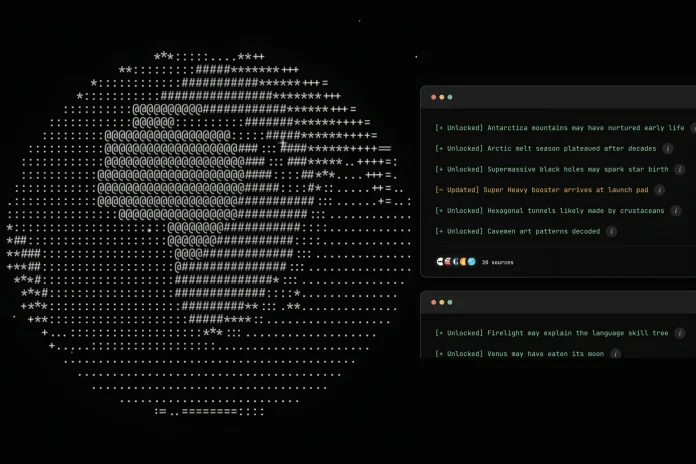
If the planet had its own change log with all the cool new discoveries or the occasional nerf. This is the concept that Earth’s Changelog is an unofficial website that has been sharing real-world achievements similar to a video games popular update system.
Covered by Dexerto on September 21, 2026, the project presents developments in science, technology, medicine, conservation, and space in a format familiar to gamers. But before anyone starts waiting for Earth’s next official update, there’s an important distinction: this is an independent editorial project, not a government, United Nations, or scientific institution.
The website features labels such as Added, Unlocked, Updated, and Nerfed, with the goal of showcasing important advancements while giving an alternate spin to the often overwhelming constant doom and gloom of modern news cycles.
Some of the examples of what has been added or unlocked in Earth’s latest changelog includes decoded prehistoric cave paintings, antarctic research, medical breakthroughs, and a claim that Venus may have eaten its moon.
The goal of the website was stated by the creators as,
“We made changelog.earth to keep track of the good things that are easy to miss in the news.”
This gamified approach allows people to be able to read about scientific advancements without having to first read a dry paper on the subject first.
Among the most eye-catching headlines is one that talks about a scientific study carried out by astrophysicist Stephen Kane and his team at the University of California, Riverside.
In their scientific paper entitled ‘Tidal Demise: The Evolution and Fate of a Hypothetical Venusian Moon,’ they explain how the planet’s slow rotation resulted in a hypothetical moon spiraling down and crashing into Venus.
However, the important distinction in this case is that they do not say that Venus ever had a moon. They use modeling techniques in their paper to explain how could such a moon have been formed and then later destroyed due to tidal forces.
The study’s format allows to more easily consider complex developments, but short and entertaining labels can be misleading in the case of scientific uncertainty. While the article focuses on new positive developments, it fails to present the full context and the language in the headline is generated by an AI, requiring extra attention.
The Earth did not receive an actual software update, instead this website shows it’s users a creative work that can also show that advancements are made. The most optimal way to utilize the changelog is to enjoy the creativity behind it and the references included for every entry.