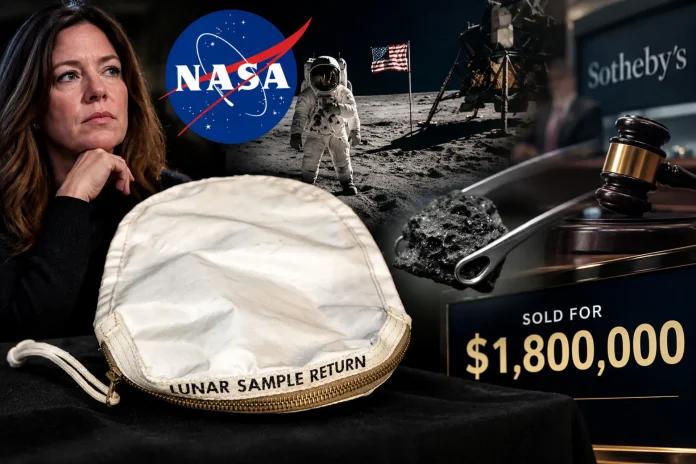
A white zippered pouch stamped “Lunar Sample Return” — the decontamination bag Neil Armstrong used to protect the very first lunar samples ever collected — sold at Sotheby’s New York on July 20, 2017 for $1,812,500, after an Illinois woman bought it at a U.S. Marshals Service online auction two years earlier for $995. The 48th-anniversary auction ended a year-long federal court fight that NASA lost to a private citizen over a piece of Tranquility Base.
The 12-by-8.5-inch Beta-cloth bag’s journey from the Sea of Tranquility to a Sotheby’s catalog lot illustrates a five-link provenance chain that broke at every stage. A clerical mix-up at the Kansas Cosmosphere mis-catalogued the Apollo 11 pouch as a bag flown on Apollo 17. Federal investigators seized it from the home of a convicted museum director in 2003. The U.S. Marshals Service then forfeited it as part of a restitution order, listed it for auction, and let it go for under a thousand dollars. NASA recognized the bag in 2015, refused to return it, and lost a courtroom battle to a real estate attorney from Inverness, Illinois, named Nancy Lee Carlson.
Sotheby’s offered the pouch as Lot 102 of its first-ever dedicated “Space Exploration” auction, timed to the 48th anniversary of the Apollo 11 moon landing. The auction house had pre-estimated the bag at $2 million to $4 million, and the realized price, including buyer’s premium, fell short of that range but still set the record for a NASA-mission space artifact. According to collectSPACE, Cassandra Hatton, Sotheby’s vice president and senior specialist, called the bag “the rarest and most important space exploration artifact to ever be offered.” The hammer price was not disclosed by Sotheby’s, and the buyer remained anonymous — as is customary in phone bidding — and has not publicly identified the bag’s current location.
If the result had cleared $2,882,500, the bag would have surpassed the standing record for a space artifact set by the sale of a Soviet Vostok 3KA-2 capsule in 2011. The Apollo 11 pouch fell roughly $1 million short of that mark, but the auction was still the first legal sale of any artifact flown on the Apollo 11 mission, according to Jim Hull, head of exhibits and artifacts at NASA, in a statement to Newsweek at the time.
Nancy Lee Carlson, a real-estate attorney from Inverness, Illinois, won the bag at a U.S. Marshals Service online auction in February 2015 for $995, alongside a mesh cushion. The Marshals had listed the pouch after seizing items connected to a federal criminal case against Max Ary, the former director of the Kansas Cosmosphere and Space Center in Hutchinson. Earlier auction attempts had failed: when the lot first surfaced in 2014, a $20,000 minimum drew no bids.
The case mirrors other recent federal-seizure-to-auction stories Hypefresh has tracked, including the IRS’s auction of 6ix9ine’s seized jewelry and RIAA plaques, where government-restitution auctions routinely attract rock-bottom bids on items whose true market value surfaces only after authentication.
Ary directed the Cosmosphere from 1976 until 2002. Federal investigators searched his garage in 2003 during a probe into missing museum artifacts. In 2005, a jury convicted Ary on 12 federal counts including theft of government property, wire fraud, and money laundering. On May 15, 2006, a federal judge sentenced him to three years in prison and ordered him to pay $132,374 in restitution. According to the Cosmosphere’s public history, Ary served roughly two years of that sentence at the Federal Correctional Institution in El Reno, Oklahoma, beginning April 24, 2008, and was released in June 2010. He has repeatedly maintained his innocence. The Cosmosphere saga also echoed broader questions about how museums safeguard items on loan, where routine catalog errors can have irreversible downstream consequences.
The Apollo 11 contingency bag was among the items seized during the 2003 search. The Cosmosphere had been loaned the pouch by NASA, but a clerical mix-up in museum inventory records caused officials to treat it as a less significant flown artifact — and later, as part of Ary’s personal collection to be forfeited under the restitution order. NASA’s internal error was even more specific: the agency’s inventory confused the Apollo 11 pouch with a similar-looking bag flown on Apollo 17, the final lunar landing mission in December 1972, according to reporting from Smithsonian magazine and The Vintage News.
Carlson sent the pouch to NASA’s Johnson Space Center in Houston for authentication. Ryan Zeigler, the agency’s Apollo sample curator, confirmed the presence of lunar dust matching Tranquility Base material. Once NASA realized the bag had flown on Apollo 11, it refused to return it, arguing in a public statement that the artifact “belongs to the American people” and had never been properly released from government property.
Carlson sued in federal court in both Kansas, where the forfeiture originated, and Texas, where NASA was holding the bag.
In December 2016, the U.S. District Court for the District of Kansas ruled in Carlson’s favor, finding she was “a good faith purchaser, in a sale conducted according to law.” Marten emphasized that the government had no statutory authority to unwind a completed U.S. Marshals Service auction, even when the asset should not have been offered in the first place. “NASA was a victim in this case, not a wrongdoer,” Marten stated.
A Texas federal judge subsequently ordered NASA to hand the bag over. Officials returned it to Carlson at Johnson Space Center in February 2017.
Carlson later said she decided against keeping the bag at home for security reasons and consigned it to Sotheby’s. According to NPR, she planned to direct a portion of the proceeds to charities including the Immune Deficiency Foundation, a Michigan children’s therapy center, and a scholarship at her undergraduate alma mater.
Not everyone supported the sale. Michelle Hanlon, co-founder of For All Moonkind Inc., an advocacy group for the protection of Apollo lunar landing sites, condemned Carlson’s decision in a statement quoted by Smithsonian magazine: “The bag belongs in a museum, so the entire world can share in and celebrate the universal human achievement it represents.”
Carlson filed a second lawsuit in January 2018, also in the U.S. District Court for Kansas, alleging that NASA had damaged the bag during testing at Johnson Space Center, that lunar particles had been improperly lifted onto testing tape, and that the agency’s public statements had depressed the artifact’s market value. NASA returned most of the material and made an undisclosed payment to Carlson; the remaining matters were resolved separately.
The anonymous Sotheby’s buyer has never publicly identified the bag’s current location. Court records from the District of Kansas and the Southern District of Texas, along with contemporaneous reporting from collectSPACE and the Associated Press, document the sequence from the Cosmosphere seizure through the final auction.
The episode has become a frequently cited case study whenever government-held space artifacts change hands through forfeiture or restitution auctions. Hypefresh has covered similar controversies elsewhere, including NASA’s public rebuttal of celebrity moon-landing skepticism and the IRS’s auction of seized rapper memorabilia, where authentication-driven valuation jumps of more than a thousandfold have raised the same questions about how government agencies safeguard property before it enters the auction pipeline.