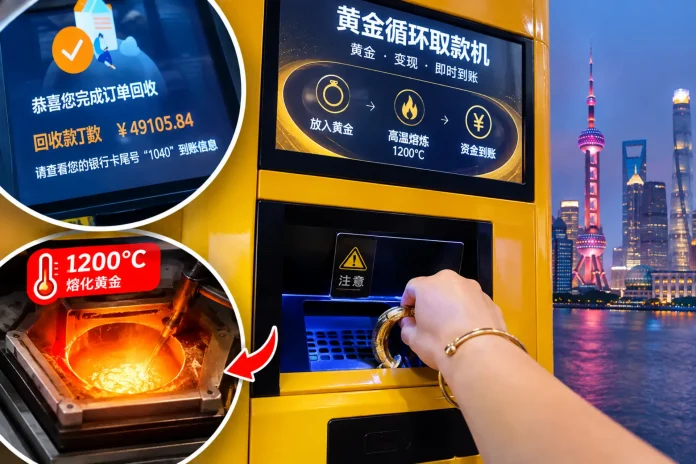
A gold-recycling ATM that melts jewelry at roughly 1,200 °C and pays users by direct bank transfer in under 30 minutes has been drawing appointment-only queues at a Shanghai shopping mall since opening on April 16, 2025, and the technology behind it has spread to 40 Chinese cities since then. Hypefresh has tracked this story from its debut, when footage of molten gold glowing inside a sealed chamber went viral on X. The spread has now reached U.S. readers through trade press this month, even though no Kinghood Group unit has crossed the Pacific.
For American readers the device lands in a strikingly different market than the one it was built for. U.S. retail gold buyers — Cash4Gold, Liberty Gold and Silver, JM Bullion, the pawn chains — still operate on in-person counters, mailed-in kits, or appointment-only assay windows. A shopper in Manhattan who walks in with a 40-gram chain today is likely to wait days for an offer, then haggle over the spread between bid and ask. The Chinese customer in Putuo District, by contrast, drops the piece in a tray and walks out in half an hour with a number on a screen and cash in an account.
According to Mining.com, the machine is operated by Shenzhen-based Kinghood Group as part of its Smart Gold Store system and accepts gold items heavier than 3 grams with at least 50 percent purity. The process weighs the deposit, runs an X-ray fluorescence scan for an initial purity read, melts the material at temperatures above 1,000 °C in an induction-heated sealed chamber, then re-assays the cooled bead against the live price from the Shanghai Gold Exchange benchmark. A flat service fee of 18 yuan (about $2.50) per gram is deducted before the net amount lands in the user’s linked bank account. Mugglehead Investment Magazine described a working example: a 40-gram necklace appraised at 785 yuan (roughly $108) per gram produced a payout exceeding 36,000 yuan, or about $4,900, after fees.
“The introduction of smart gold ATMs primarily serves a recycling function from a business perspective,” Xu Weixin, a member of the Shanghai Gold Association, told the China Times. “With rising gold prices, there’s a stronger desire to cash out. The upward momentum is largely driven by central banks and institutional investors increasing their gold reserves.” Mining.com reported that Xu advised sellers not to rush, noting that gold was still “trading above $3,400 per ounce” on COMEX and above 1,000 yuan (about $137) per gram on the domestic spot market on launch day.
Kinghood brand general manager Xiao Yingjie told the China Times in August 2024 that the international version of the unit “will integrate with local physical gold trading markets, gold prices and third-party payment platforms to facilitate settlements in all major global currencies,” according to Mugglehead. Kinghood’s Shanghai operations manager Xie Chengcheng confirmed to the China Times in April that the company was targeting more than 100 machines inside Shanghai alone, on top of units already in Beijing, Guangzhou, Shenzhen and Hong Kong.
The hardware package runs X-ray fluorescence for the initial elemental scan, then induction melting for the confirmatory assay. High-precision electronic scales compatible with major global measurement units and a universal detector rated to 0.01 percent accuracy come standard, per the company. Live camera feeds and robotic handling let users watch the melt on screen, with identity verification and bank-account details entered before the final transfer. Mobile-phone registration is available in more than 200 countries, per the company, with multi-currency payments in at least half of them.
Demand has stayed strong because Chinese households accumulated jewelry over decades at lower cost bases. With global spot at approximately $3,400 per troy ounce — roughly $109 per gram on the World Gold Council’s benchmark — the value of any gold that has been sitting in a drawer since the 2000s has multiplied. The machines also remove the haggling and paperwork that drive some older sellers to keep their jewelry at home. Traditional gold buyers in Shanghai told the China Times that the automated unit has eaten into their traffic: a sales representative for China Gold at the mall said the store’s buyback rate, 715 yuan per gram, is below the ATM’s offer, and the gap has pushed walk-in customers toward the machine. U.S. retailers like JM Bullion still publish live spot but rely on mail-in or in-person appraisal rather than a fully automated melt-and-pay pipeline.
That competitive pressure is one reason U.S. readers should pay attention: American gold-buying has its own share of public-safety incidents, including the recent Dallas jewelry-store heists that drained millions in merchandise, and any move toward automated American gold-recycling terminals would have to clear a thicker regulatory layer. State-level pawnbroker and secondhand-dealer licensing, federal 1099 reporting thresholds, and the consumer-protection scrutiny that has hit mail-in gold buyers in recent years would each apply. U.S. retail-tech rollouts have already sparked biometric-privacy fights over how customer data is handled, a fight that would almost certainly meet any all-in-one jewelry and ID reader at the mall door.
Kinghood’s Smart Gold Store concept debuted in 2019 and won the manufacturing-innovation award at the 2024 JWA Sustainability Awards, organized by Informa Markets Jewellery, according to Mining.com. Trade press reports the international version is now sitting in Macau through a partnership with GoldSmart. Whether the model makes it to North America remains an open question: the transparency and speed that have made it a hit in Putuo District would have to survive a regulatory and consumer-protection gauntlet that Kinghood has not yet had to navigate. For now, the lines in the Global Harbor mall are a reminder that when gold prices rise high enough, even a trip to the jeweler can be replaced by a trip to the vending aisle.