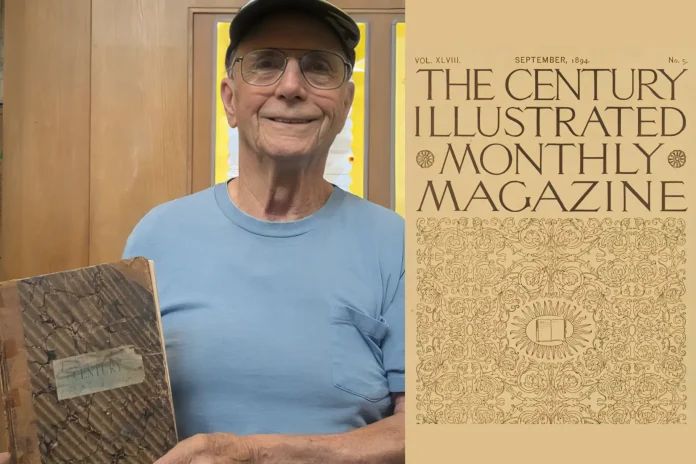
An 84-year-old New Hampshire man walked into Concord Public Library earlier this month carrying a September 1894 issue of The Century Illustrated Monthly Magazine. The periodical had been missing for roughly 132 years exactly 48,220 days overdue.
John Hanson, a Barrington resident and Concord native, handed the bound volume to archivist and outreach coordinator Jennifer Needham at the circulation desk. Needham expected something from the 1980s or 1990s. Instead she got a late-19th-century magazine still bearing the original Concord Public Library bookplate and the notice that it “may be kept for one week.”
“I honestly thought it was going to be from the 1980s, ’90s or 2000s,”
Needham recalled.
“But then he pulled this out, and I was like, ‘Ooo, tell me more!’”
Hanson said the magazine had sat on his bookshelf for decades, first in Boscawen and later in Barrington. He first noticed it during a house move around 1966. “I have no idea where I got it,” he told the Concord Monitor.
“I’ve had it for years and years. My father was born and grew up in Concord, but he didn’t have a library card. I don’t know about my grandparents. I don’t know if it was something that I found at an ad sale or in a pile of books or what.”
His late first wife, Carol, was a frequent library user who would never have kept anything overdue.
At the previous price of 25 cents per day, the maximum fine would be $12,055. Hanson owes nothing. On September 1, 2026, Concord Public Library launched a “fine-free” period for a whole year. During this time, the library will neither add overdue fines to users’ accounts nor collect old fines. The experiment seeks to check if the elimination of fines helps people return books and visit the library more often. However, people who lose or damage books, as well as those who have more than five overdue items, still face obstacles.
Hanson spotted a Concord Monitor story about the freeze while at the grocery store.
“I saw that they were taking in books with no fine, and I said, ‘Boy, this is a good time to bring it in,’”
He said. Library Director Todd Fabian had hoped long-missing items would surface; staff got more than they expected.
The magazine itself remains in relatively good condition despite its age. Some pages show crayon coloring, hinting a child once used it. One article discussed the need for outdoor playgrounds at urban public schools an early argument for children’s play space. Needham noted the historical interest:
“I didn’t know this history, that they were arguing that more city schools should have outdoor spaces for children to play.”
Staff verified the bookplate, issue number and date to confirm the item had never been deaccessioned. It will not return to normal circulation. Officials plan to preserve or display it in the library’s Concord Room, which holds local history materials. The library, founded in 1873, was only about 20 years old when the magazine first left the building.
One can ask the following practical question after watching this episode: Does the absence of overdue fines mean that books are being returned?