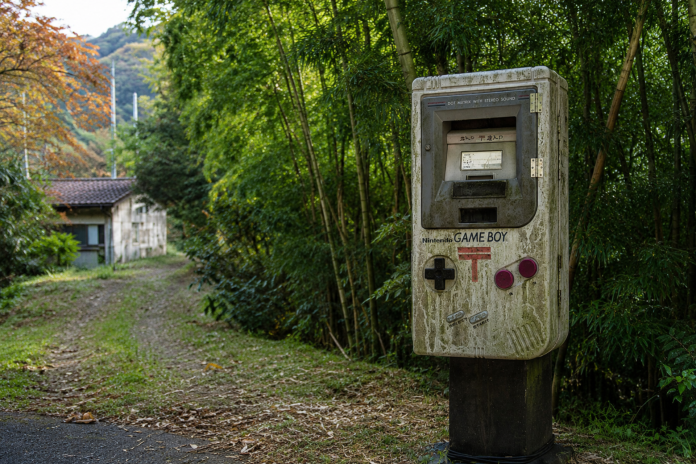
A giant Nintendo Game Boy that has been quietly decaying in the mountains of Kagawa Prefecture, Japan for years went viral again this week after a tweet about the relic drew nearly 1,000 likes in hours, and the story it tells is a small lesson in how a 37-year-old promotional kiosk escaped the normal Nintendo retirement circuit to become a private mailbox, a tourist curiosity and a growing collector’s-item category all at once.
A comparable unit of the same model sold for 2.2 million yen, about $15,000, at a Hard-Off store in Seki, Gifu, in October 2025, less than two weeks after the store’s grand opening, according to Anime News Network’s report on the October 2025 Hard-Off sale. The Kagawa Game Boy is not for sale. It sits in private hands along a mountain road, slowly rusting. That it has any value at all is the unusual part of the story.
The object is a Big Game Boy, model BGB-001, a real Nintendo promotional display built in 1989 to push the original Game Boy, which Nintendo had launched in Japan on April 21, 1989. The original Game Boy went on to sell about 118.69 million units, making it the fourth best-selling video game console of all time, per Wikipedia’s Game Boy entry. The BGB-001 kiosks were made in small numbers and distributed to authorized retailers as in-store demo units. Nintendo normally collected them back after the promotional campaign ended, which is why surviving examples are scarce enough that one cleared more than the price of a used car last fall.
How the Kagawa unit ended up on a mountain road is the part nobody has fully documented. The most detailed primary record comes from the Komatsu Municipal Museum’s BGB-001 catalog record in Ishikawa Prefecture, which covers a separate surviving unit that was used at a toy store called Kitase in Komatsu City from about 1989 to 1995. The record identifies Nintendo as the manufacturer and describes the unit as a large promotional display carrying a built-in LCD monitor and a standard Game Boy connected by cable, so customers could see gameplay on a larger screen. Surviving examples stand roughly 1.5 to 1.6 meters tall, roughly the height of a below-average-stature adult, based on a 2016 Yahoo Auctions listing for a comparable unit.
That rarity is also why the BGB-001 has quietly become one of the more interesting collectibles in the Nintendo hardware universe. The category still lives in the shadow of rare-collectible discoveries like sealed retro game lots, where condition and grading can drive prices into six or seven figures. The BGB-001 skips the grading question entirely, since the units were never sold retail and almost none survived in original packaging. Nintendo built them as retail furniture, meant to be displayed for a few months and then returned. The ones that did survive are usually missing parts.
At the Kagawa site, someone repurposed the cabinet in the opposite direction and the screen area was cut open to fit a mailbox compartment. The familiar oversized Game Boy buttons are still there on the front, where they have never done anything useful. The original front buttons were for show, since the actual gameplay happened through the built-in Game Boy. What looks like an indoor-use marking and an old power socket are still visible on the housing, reminders that the cabinet was built for a brightly lit store interior, not for years of mountain weather.
The Japanese outlet J-Town Net asked the local post office about the cabinet in 2019, according to Offbeat Japan’s June 2026 field writeup, a Tokyo-based urban-exploration site that revisited the location this summer. The answer: it is not an official Japan Post collection box. It is a private mailbox on private land, and any mail placed inside it does not enter the postal system. A postcard left in the slot goes nowhere. That is the kind of detail that makes the object funnier and sadder at the same time.
The site sits somewhere in the hills near the Okawa Post Office in Sanuki City, on the island of Shikoku. Privacy concerns have kept the exact location out of published reports, although visitors have shared photos on Reddit, Imgur and elsewhere for years. SoraNews24’s 2016 original coverage and grape Japan’s 2020 rediscovery story described the cabinet as overgrown but upright. More recent visitor reports describe rust, loosened parts, creeping vegetation and a slow tilt in a structure that was never meant to stand outside in the first place.
The Game Boy is also one of several other strangely repurposed mailboxes that have caught a viral cycle in recent years, from the Florida man’s gun-shaped box that drew police attention in 2024 to a rotating cast of celebrity-shaped novelty boxes in Japanese rural towns. Most of those mailboxes stay online for a few days and disappear. The Kagawa one has been showing up in posts and forums for almost a decade, which is part of why the Sept 3 tweet picked up where the earlier Reddit and Imgur posts left off.
What happens next to the Kagawa mailbox is up to its owner. The cabinet could stay where it is and keep weathering until it is no longer recognizable as a Game Boy. It could be sold, in which case it almost certainly leaves Kagawa and ends up in a Japanese private collection, alongside Nintendo’s recent LEGO Game Boy release and the small but active auction market for surviving BGB-001 units. It could be acquired by a museum, though no Japanese museum has announced an interest. For now it sits where it has sat for years, half-buried in bamboo, the kind of object that resists being filed away as either a tourist attraction, a piece of gaming history or a piece of rural Japanese junk. It is all three, and that is the part of the story a single photograph will never quite capture.