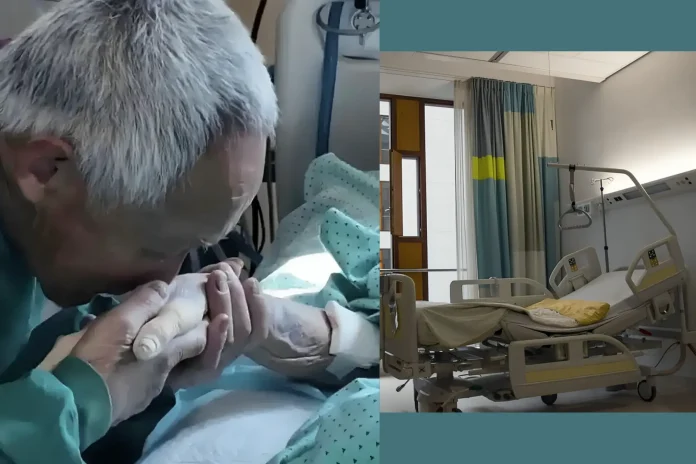
An 82-year-old farmer from rural China spent 105 days making a 12-hour round-trip bus journey just to sit with his wife for 30 minutes in the intensive care unit. The story of Chen Achong and his wife Xue has touched millions online.
Chen Achong and Xue had been married for over 50 years. They lived a simple life in Jintang Town, Zhoushan, Zhejiang. Xue had a stroke a year ago. She also got severe pneumonia and esophagus problems. She needs tube feeding. In late November 2025, Xue was admitted to the ICU in Li Huili Hospital in Ningbo. Their son sold his house to pay the medical expenses. Chen Achong took care of her.
Every morning at 4:30 a.m., Chen would wake up, prepare a fresh meal for his wife, and set off. This involved a series of bus changes. His trip would take about 12 hours. Chen would arrive just in time to visit within the 10:30 a.m. to 11:00 a.m. slot.
“I told her the family was doing well and not to worry,”
Chen remembered.
“Within those 30 minutes, I held her hand, wiped her face, adjusted her blankets, and talked about our life.”
Chen would often wait in the hospital corridors for hours before going back home tired. This was a daily routine Chen maintained for 105 days. Chen spent more than 100,000 yuan, or $14,000 of his savings, on his wife’s treatment.
A tweet from X.
On 13 March 2026, Chen visited as usual. Xue seemed stable and even nodded when he spoke to her. As he prepared to leave, the hospital called. Her heartbeat had stopped. Chen and his son rushed back. Doctors tried to revive her, but she passed away at age 76. Chen held her hand in her last moments.
“My heart feels like it is being torn apart. It is so painful. But nothing more could be done,”
He said later. He described their final goodbye with quiet sorrow:
“This life ends here… Our bond in this life is over.”
He called her “the best wife in the world” and said he plans to visit her grave regularly.
The story first spread on Chinese platforms Douyin and Weibo after local media, including CCTV and Xinwenfang, reported it. It quickly crossed borders through outlets such as the South China Morning Post, NDTV and The Star. Netizens praised Chen’s quiet devotion. The donations poured in, with more than 140,000 yuan, or roughly $20,000, being raised to pay off outstanding medical bills. The hospital also granted greater visiting flexibility to the patient, and bus companies waived his bus fares.
The story has also fueled a broader discussion in China about healthcare costs and rural healthcare, where people travel long distances to receive specialist care and face high out-of-pocket costs. And it highlights the influence of social media to turn a personal act of devotion into a social phenomenon. In an era of quick-scroll videos, Chen’s steady, unspoken sacrifice stood out. As one netizen wrote, it reminded people of the older generation’s lifelong loyalty. Even after Xue’s death, the response highlights how digital storytelling can ease real burdens and honour quiet devotion.