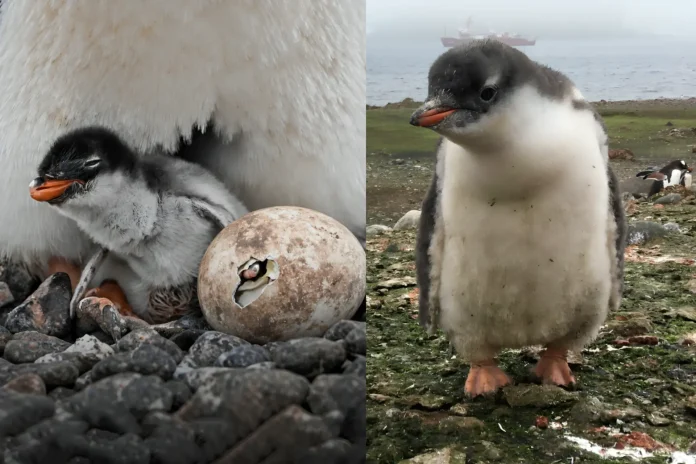
On the windswept Kerguelen Islands in the southern Indian Ocean remote outposts also known as the Desolation Islands thousands of penguins have nested for generations among rocky shores and fierce winds. They look nearly identical to other gentoo penguins: black backs, white undersides, and the distinctive white eye-band. For more than a century, scientists collected them without suspecting anything unusual.
Modern genomics has now revealed the surprise. These birds are a distinct species, Pygoscelis kerguelensis, the southeastern gentoo penguin the first newly named penguin species in more than 100 years.
The formal recognition came in a peer-reviewed study published April 23, 2026, in Communications Biology. An international team led by researchers including Daly Noll of the University of Chile, with senior authors Juliana Vianna, Rauri C. K. Bowie of UC Berkeley, and Elie Poulin, analyzed whole-genome sequences from 64 gentoo penguins across 10 breeding colonies spanning nearly the group’s full range. They combined the genetic data with body measurements, vocalizations, diet, feeding behavior, breeding timing, and ecological observations.
The analysis showed that what had long been treated as one widespread species, Pygoscelis papua, actually comprises four separate evolutionary lineages that diverged roughly 300,000 to 500,000 years ago. The southeastern gentoo, centered on the Kerguelen Islands and likely nearby Heard Island, accounts for about 9 percent of the former gentoo population. It is a classic cryptic species: nearly identical in appearance, with only subtle differences in size and calls.
The other three lineages elevated to full species are the northern gentoo (P. papua, mainly Falkland/Malvinas and South American sites), the southern gentoo (P. ellsworthi, Antarctic Peninsula and nearby islands), and the eastern gentoo (P. taeniata, Crozet, Marion, and Macquarie Islands). Geographic isolation, strong site fidelity, limited long-distance movement, and the Antarctic Polar Front a major ocean barrier of temperature and salinity drove the separation.
The holotype specimen was collected by explorer Robert Hall on Kerguelen on December 31, 1897. Earlier researchers lacked genomic tools, so the birds remained classified with other gentoos despite being known for generations.
Recognizing four species changes risk assessments. Climate models project that the three island-based lineages, including P. kerguelensis, could lose most or all suitable habitat by around 2050 under moderate warming. The southern Antarctic population appears more resilient and may expand. Additional pressures include warming oceans, declining krill, fisheries, introduced predators, and disease.
This is taxonomic recognition of a long-misclassified population, not the sudden finding of an unknown animal. Specimens existed in museums for over a century; genomics simply proved the genetic separation.
New tools continue to uncover hidden biodiversity in the Southern Ocean. Understanding these distinct lineages is essential as climate change reshapes their isolated homes.