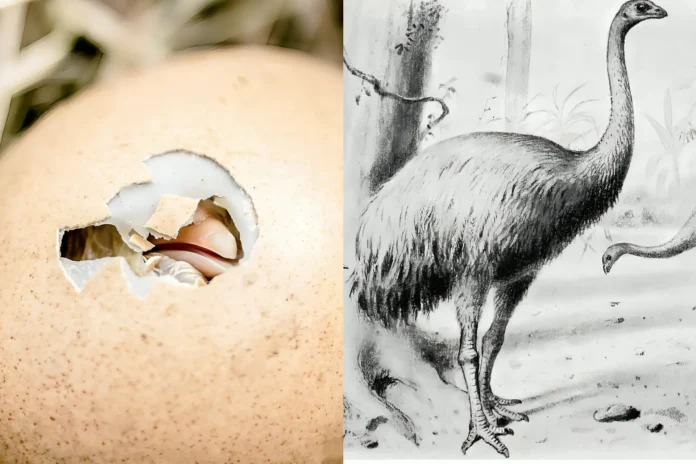
Videos of fluffy yellow chicks pecking their way out of crystal-clear, high-tech shells exploded across social media this week. Users on X, TikTok, and Reddit called it “Jurassic Park happening in a lab.” Dexerto and other outlets quickly picked up the story, linking the experiment to Colossal Biosciences’ bigger dreams of bringing back extinct giants like the South Island moa.
The Dallas-based biotech company announced on May 19, 2026, that it had successfully hatched 26 healthy chicken chicks using custom 3D-printed artificial eggshells. Researchers transferred fertilized chicken embryos into rigid plastic lattice structures lined with a thin silicone membrane. This setup mimics the natural eggshell’s ability to allow oxygen in and carbon dioxide out through passive diffusion no extra oxygen tanks required.
The transparent design let scientists watch embryo development in real time over the standard 21-day chicken incubation period. All 26 chicks survived and are now thriving at Colossal’s Texas facility, some already several months old.
This isn’t just about chickens. Colossal positions the breakthrough as a key step toward reviving the South Island giant moa, a flightless New Zealand bird that stood up to 12 feet tall and went extinct about 600 years ago, largely due to human hunting. Moa eggs were massive roughly 80 times the volume of a chicken egg too big for any living bird to incubate as a surrogate.
A tweet from X.
CEO Ben Lamm called the project a major advance.
“Every new scalable system for de-extinction is ultimately a biology problem wrapped in an engineering problem,”
He said.
“At Colossal, we didn’t just replicate the egg; we re-engineered it from first principles to create something more scalable and controllable.”
Chief Science Officer Beth Shapiro and the team see applications for conserving endangered birds facing hatching problems in captivity too.
Some experts note that shell-less chick culture techniques have existed in research for years, though Colossal claims improvements in scalability and no need for supplemental oxygen. Peer-reviewed data is still pending, and critics like evolutionary biologist Vincent Lynch have pushed back, calling it “not a moa, just a genetically modified bird” in broader discussions.
Supporters hail it as biotech progress. Skeptics worry headlines overpromise what the tech can deliver right now.
This experiment raises big questions. Could artificial eggs reshape conservation and one day help resurrect lost species? Or is the internet once again racing ahead of the science? For now, 26 real chicks in Texas prove the engineering works. The rest remains a work in progress.