

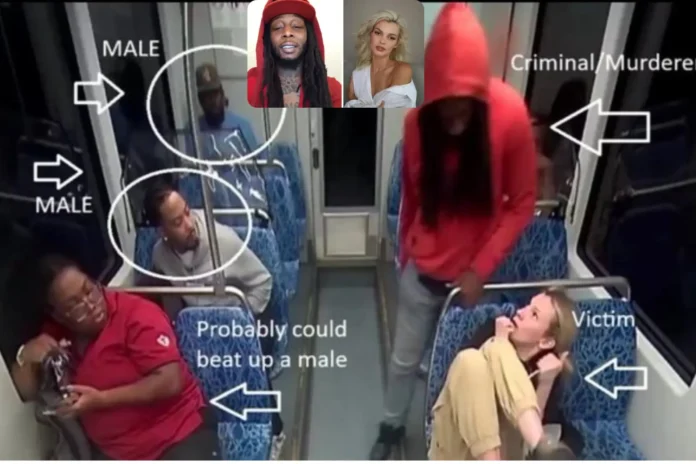
A young woman’s escape from the war in Ukraine ended in a brutal, unprovoked attack on a Charlotte train, stabbing, exposing deep cracks in society that have sparked outrage across the nation. On August 22, 2025, Iryna Zarutska, a 23-year-old Ukrainian refugee, was fatally stabbed by 34-year-old Decarlos Brown Jr. aboard the Charlotte Area Transit System (CATS) Lynx Blue Line.
Newly released surveillance footage, made public on September 5, captures the chilling moments of the attack. Zarutska, dressed in her Zepeddie’s Pizzeria uniform, sat engrossed in her phone, wearing headphones, unaware of Brown seated directly behind her. At 9:50 p.m., near Scaleybark station in Charlotte’s vibrant South End, Brown pulled a folding knife from his hoodie, paused briefly, and stabbed her at least three times in the throat and chest.
Blood dripped as Zarutska clutched her face in shock, slumped from her seat, and bled out on the train floor. Brown walked to the other end of the car, removing his red hoodie and muttering,
“I got that white girl, I got that white girl,”
According to witnesses. The extended video reveals a haunting detail: it took exactly 94 seconds for a passenger from the front of the train to notice and attempt to render aid. Five passengers seated near or behind Zarutska stood and walked away, one choosing to record her final moments rather than intervene.
At 9:52 p.m., the train stopped at East/West Boulevard station, where police arrested Brown on the platform, recovering the knife nearby. Brown sustained a minor hand injury, possibly from the attack, and was treated before being charged with first-degree murder. On September 9, the U.S. Department of Justice added a rare federal charge of committing an act causing death on a mass transportation system, making Brown eligible for the death penalty.
Zarutska fled Kyiv, Ukraine, with her mother and siblings in 2022 to escape Russia’s invasion. A gifted artist with a degree in Art and Restoration from Synergy College in Kyiv, she adapted quickly to life in Charlotte, becoming fluent in English and enrolling at Rowan-Cabarrus Community College from 2023 to 2025. Known for her radiant smile and generosity, she worked at Zepeddie’s Pizzeria, loved animals, and dreamed of becoming a veterinary assistant.
A GoFundMe for her family has raised over $149,218, reflecting widespread grief. “She left Ukraine to make her life better, and ended up getting murdered just being in the wrong place at the wrong time,” said a family friend named Lonnie.
Brown, a homeless Charlotte resident, had a criminal record spanning over a decade, with 14 arrests in Mecklenburg County for offenses including armed robbery, felony larceny, breaking, and communicating threats. In 2014, he was convicted of robbery with a dangerous weapon after brandishing a handgun and stealing $450, a cellphone, and Honduran currency, serving over six years in prison until his release in September 2020.
In January 2025, he was arrested for misusing 911, claiming a “man-made” material controlled his actions, a sign of his documented schizophrenia. His mother, Michelle Dewitt, told local media she sought an involuntary commitment order after his erratic behavior. Still, the system failed to secure long-term care because she wasn’t his legal guardian. In 2024, Charlotte-Mecklenburg Police referred Brown to mental health resources three times, but he refused help.
Critics point to his release on cashless bail in early 2025 as a key failure, blaming lenient policies for allowing a known risk to remain free. The case has escalated to a federal level due to the transit system’s interstate implications, with the Trump administration vowing to seek the death penalty. Attorney General Pamela Bondi stated Brown would “never again see the light of day as a free man.” President Trump called the attack “horrible” and criticized Democratic-led cities, while figures like Elon Musk amplified the case on social media, framing it as evidence of urban crime crises. Charlotte Mayor Vi Lyles called the killing a “senseless and tragic loss,” acknowledging a “tragic failure by the courts and magistrates” and pledging more transit safety measures.
North Carolina Governor Josh Stein, a Democrat, pushed for increased police funding, while Republicans like Rep. Brenden Jones blamed “woke” policies for Iryna Zarutska’s death.
This tragedy reveals a deeper societal unraveling, marked by failures in criminal justice, mental health care, and public empathy. Brown’s repeated releases, including on cashless bail, highlight a system struggling to balance reform with public safety.
A 2023 report noted that lenient bail policies can increase recidivism among violent offenders, with the Charlotte train stabbing as a stark example. Defenders of reform argue that over-incarceration harms marginalized groups, but Brown’s untreated schizophrenia, not just policy, drove his actions. His mother’s failed attempts to secure care reflect a mental health system where involuntary commitment is difficult, and voluntary treatment often goes unaccepted.
A 2021 report found that 55% of people with serious mental illnesses receive no treatment due to access barriers or refusal, leaving communities vulnerable.
The inaction of five passengers, one recording Zarutska’s final moments, underscores the bystander effect, where individuals fail to act in emergencies, assuming others will intervene. A 2019 study found that bystander inaction increases in urban settings due to diffusion of responsibility and desensitization to violence. The passenger who recorded reflects a troubling trend of prioritizing viral content over human life, amplified by social media’s reward for shocking footage.
Posts on X condemned this as “zero courage,” linking it to an erosion of community responsibility.
Social media amplified the outrage, with hashtags like #IrynaZarutska and #CharlotteStabbing trending. Some right-wing commentators framed the attack as racially motivated, citing Brown’s post-attack comments, though police have not charged him with a hate crime. Others argue this focus distracts from systemic issues like poverty and mental health.
Charlotte’s response—bolstering transit security with more fare inspections and officers—addresses symptoms but not root causes. The Ukrainian Embassy’s statement of support for Zarutska’s family underscores the international weight of this failure, as a refugee fleeing war found no safety in America.
Iryna Zarutska’s murder demands a reckoning with a criminal justice system that releases dangerous offenders, a mental health system that fails the sick, and a society where bystanders choose to record rather than act. Charlotte and America must confront these failures to prevent further tragedies.
