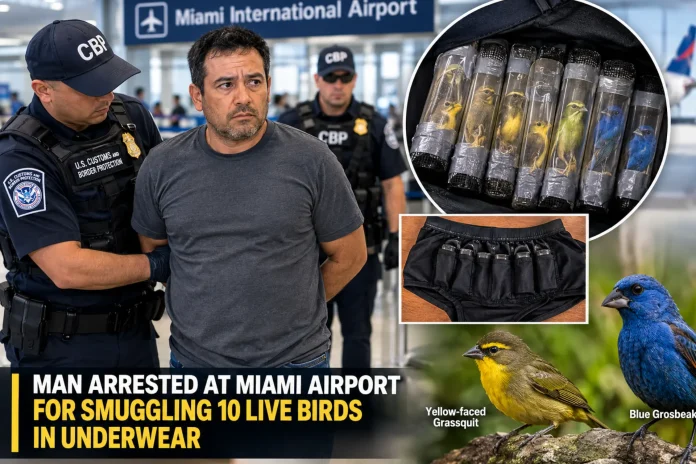
A 40-year-old Cuban native and U.S. lawful permanent resident landed at Miami International Airport on October 4, 2026, with an “unexplained bulge” near his waist that turned out to be 10 live birds stuffed into plastic tubes sewn into his underwear.
Alberto Hernandez Castillo stepped off a flight from Havana. Customs and Border Protection officers selected him for secondary inspection. He had checked “no” on his declaration form about bringing animals or wildlife into the country. Officers searched his carry-on bag and fanny pack and found nothing. Then they noticed the bulge and that he appeared nervous.
They took him to a private area for a pat-down. According to the federal criminal complaint, that search uncovered six clear cylindrical plastic tubes wrapped in tape. Some had black mesh openings for ventilation. The tubes sat inside black pockets sewn into his underwear. Inside were eight yellow-faced grassquits and two blue grosbeaks all alive.
Castillo told officers the birds were for his “personal use.” He then invoked his right to remain silent. Investigators found no record that he had the required U.S. Fish and Wildlife Service documentation for lawful importation.
The yellow-faced grassquit is a small, seed-eating songbird found in the Caribbean region. The blue grosbeak is protected by the Migratory Bird Treaty Act, meaning that transport and imports are not allowed without authorization. The importation of live animals to the U.S. usually involves declarations and permits among other processes, failure of which results in criminal prosecution.
Reports note these species sometimes appear in the illegal pet and singing-bird trade linked to South Florida markets. The complaint does not establish that Castillo planned to sell the birds. His “personal use” statement remains the only explanation he offered.
Authorities charged Castillo with smuggling goods into the United States. He appeared in Miami federal court, was released on a $25,000 personal surety bond, and faces arraignment on October 26, 2026. He is represented by a federal public defender. The case remains pending. No conviction has been entered.
A second similar arrest at the same airport a couple of days later involved a different man and different birds. Authorities have not publicly confirmed any direct link between the two cases.
Questions linger. What exactly “personal use” meant. Whether every bird survived in good condition after seizure. Where the birds came from and where they went afterward. The U.S. Fish and Wildlife Service has said it is investigating but has not released further details on their status.
Airport officers see plenty of creative concealment attempts. This one stands out for the living cargo and the homemade sewn pockets. The legal process will decide the rest.