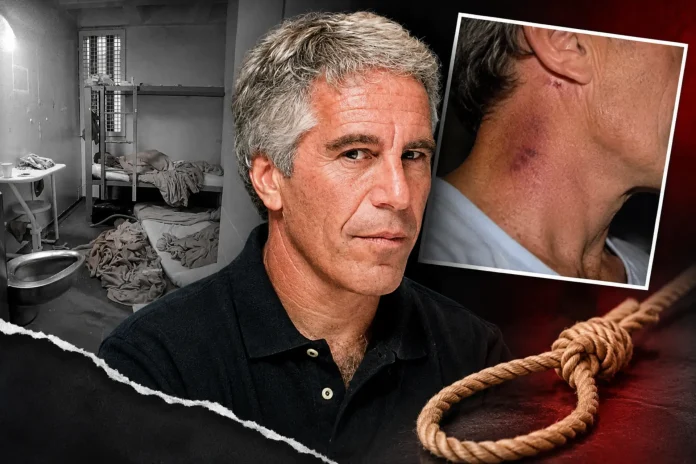
A forensic scientist who spent a year reviewing Jeffrey Epstein’s full autopsy file and photographs says the injuries point to homicide rather than the official finding of suicide by hanging.
Dr. Michael Freeman presented his conclusions on the evening of 16 November 2026 at Middle Temple, a historic legal society in London. He told audiences and interviewers that Epstein’s neck injuries are more consistent with ligature strangulation from behind, after which the same fabric was likely used to suspend the body from a bunk bed. Freeman has described the chance of suicide as “zero per cent” given the pattern of injuries documented by the New York City medical examiner and the circumstances of the discovery.
Epstein, the financier and convicted sex offender, was found dead in his cell in the Special Housing Unit of the Metropolitan Correctional Center in lower Manhattan on the morning of 10 August 2019. He was 66 and awaiting trial on federal sex-trafficking charges. The New York City Office of Chief Medical Examiner ruled the cause of death hanging and the manner suicide. That determination has stood through subsequent reviews by the FBI and the Justice Department’s Office of the Inspector General.
Freeman, editor-in-chief of the Journal of Forensic and Legal Medicine, is a professor of forensic medicine and epidemiology at Maastricht University Medical Center in the Netherlands and holds a joint clinical appointment at Oregon Health & Science University. He holds a medical doctorate from Umeå University in Sweden, a Ph.D. and master’s in epidemiology from Oregon State University, and additional qualifications including fellowship in the Royal College of Pathologists. He has testified more than 1,600 times in civil and criminal cases, including death-in-custody matters and the George Floyd case on behalf of state attorneys general. He specialises in injury causation, forensic epidemiology, and sources of bias and error in death investigations.
According to Freeman, Mark Epstein, Jeffrey’s brother, provided the complete medical examiner’s file and photographs in November 2025. Freeman states the review was independent and unpaid. He worked with Anders Eriksson, a forensic pathologist and professor emeritus at Umeå University who previously supervised Freeman’s doctoral work, and Itiel Dror, a cognitive neuroscientist who studies how bias affects forensic decision-making. The team used three-dimensional computer models built from the autopsy photographs, details of Epstein’s body, and the account of the correctional officer who found him to test how the injuries could have been produced.
Freeman has said the primary ligature mark on Epstein’s neck was deep, irregular and branched into a Y-shape rather than forming the smoother, upward-sloping line typically associated with hanging. He identified a second, lower mark at a different angle, marks he interprets as possible fingernail impressions above the main ligature, a deep haemorrhage in the left shoulder muscle consistent with blunt-force trauma, and injuries to the face and back that he believes indicate a struggle. He argues these findings are not adequately explained by suicidal hanging alone.
The New York City medical examiner’s office said on 16 November 2026 that it continues to stand by its original determination. The pathologist who conducted the 11 August 2019 autopsy later told Justice Department investigators that the injuries were more consistent with hanging than with homicidal strangulation and that classic defensive wounds were absent.
Earlier official reviews documented extensive operational failures at the jail. Correctional officers on duty failed to conduct required rounds, falsified logs, and in some cases slept or shopped online. Epstein was left alone without a cellmate despite instructions that he should not be housed alone. Excess bed linens were available in the cell. Cameras covering the common area of the Special Housing Unit did not record activity on the relevant tier after lockdown; video analysis showed no one entering that tier from the common area between roughly 10:40 p.m. on 9 August and 6:30 a.m. on 10 August.
In late July 2019, about two and a half weeks before his death, Epstein was found semiconscious in his cell with a makeshift noose fashioned from orange fabric. He told staff that his then-cellmate, Nicholas Tartaglione, a former police officer later convicted of multiple murders, had tried to kill him. Epstein was briefly placed on suicide watch and psychological observation, then removed. He reportedly told officers he had gone without sleep for approximately 20 days around that period. He signed a new last will and testament on 8 August 2019.
The officer who discovered Epstein on 10 August moved the body while attempting resuscitation. Multiple lengths of knotted orange fabric were present in the cell; questions later arose about which piece was the ligature collected as evidence. Freeman has noted that Epstein’s fingernails were not tested for DNA, an omission he regards as significant if a struggle occurred.
Freeman’s analysis has been reviewed by colleagues but has not been published in a peer-reviewed journal. He has said at least one journal declined the paper, with reviewers citing discomfort with direct criticism of a medical examiner’s findings. Victims’ attorney Spencer Kuvin has called for independent examination of the new claims so that answers provided to survivors rest on evidence rather than unresolved questions.
Freeman’s work does not identify any perpetrator and rests on reinterpretation of existing records and photographs rather than a new physical examination of the body. Official investigations continue to attribute the death to suicide made possible by systemic breakdowns at the Metropolitan Correctional Center. The presentation at Middle Temple has nonetheless returned attention to the injury pattern, the handling of the scene, and the documented failures that left Epstein unobserved for hours on the night he died.