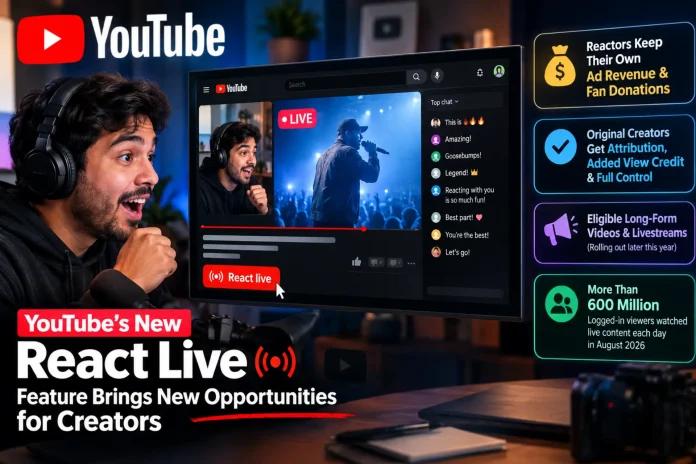
Now YouTube has provided a roadmap for reaction streamers to make money. Reaction streamers will soon be able to click on “React live” on eligible long-form videos or livestreams, stream a reaction channel of their own, and earn money from live ads and fan donations of that particular live stream.
The platform made the announcement at its Made on YouTube event on September 23, 2026. The long-form expansion of the existing “Watch With” tool is set to begin rolling out later this year.
“We’ve designed the feature with creators on both sides in mind,”
YouTube Live product lead Barbara Macdonald wrote in the official blog post.
“Reacting creators keep the live ad revenue and fan funding they earn, while original creators get clear attribution, added view credit in YouTube Studio, and full control over which of their videos can be reacted to.”
That last part is the real tension. Reactors keep the ad dollars and Super Chats from their own streams. Original creators get credit and a veto. YouTube has not said the original creator receives any share of the reaction stream’s advertising or fan funding. Whether the “added view credit” later produces extra AdSense income remains unconfirmed.
A creator clicks the “React live” option on an eligible long-form video or livestream. The creator’s webcam appears next to the original video, mostly in a merged vertical format. Fans see both the creator’s reactions along with the video.
Watch With started with major tentpole broadcasts so creators could react to big sports and events. Earlier this year YouTube tested live-to-live reactions between creators’ streams. The new step opens the feature to eligible long-form videos across the platform.
YouTube reported that more than 600 million logged-in viewers watched live content, including archives, each day on average in August 2026. That figure comes straight from the company and is not a forecast for how many people will watch reaction streams.
Exact eligibility rules for videos and creators have not been fully detailed. Desktop availability versus the earlier mobile-focused tests is unclear. How Content ID and reused-content policies will interact with these live reactions also remains to be seen. In prior live-to-live tests, original streamers kept their own stream revenue separately while reaction metrics were attributed back.
For creators who live off live energy and real-time chat, this formalizes a format many already chase. For original uploaders, it offers attribution and control without a confirmed cut of the reaction money. The dollars stay with the reactor. The credit and the question of what that credit is really worth goes to the original.