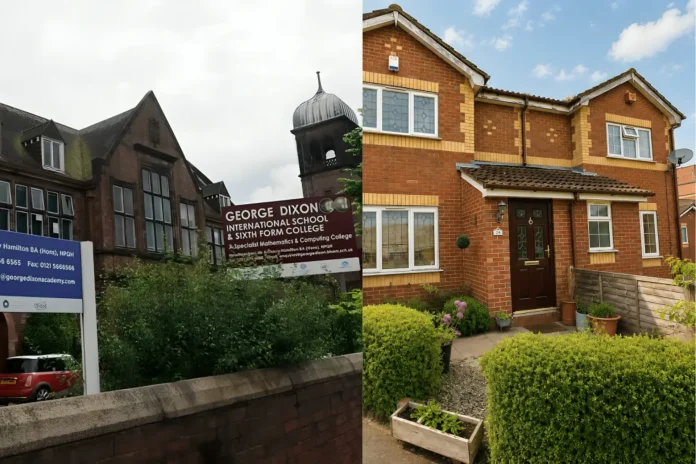
A Birmingham businessman thought he was getting a three-bedroom house. Instead, a paperwork slip handed his company the keys to an entire primary school and its grounds.
In 2013, NH Care Ltd, the care-provider company directed by Sukhjit Bains, bought a former caretaker’s cottage on Fountain Road in Edgbaston at auction from Birmingham City Council for £395,000 roughly $530,000. The house once served the neighboring George Dixon Primary School; its rear garden still backs onto the playing fields. Both properties shared the same Land Registry title number.
When the transfer was prepared, the buyer’s solicitors used a TR1 form, which moves an entire registered title, rather than a TP1 form, which moves only part of one. The council’s own conveyancer signed off without catching the mismatch. Legal ownership of the house and the school passed to NH Care Ltd.
“I don’t think I’ve ever come across anything like this in 40 years. It’s the most incredible legal cock-up I can recall,”
One legal expert who reviewed the papers told the hypefresh.
No one noticed for 11 years. The error surfaced on April 12, 2024, when the school explored converting to academy status and discovered the council no longer held the title. The school, which serves about 324 pupils, has continued operating normally the entire time. NH Care has not interfered.
Birmingham City Council later contacted the company. According to court filings reported by Local Government Lawyer and The Telegraph, officials say Bains initially agreed to return the school but then stopped responding and declined to sign rectification papers. The council has now issued High Court proceedings in London against NH Care Ltd and its lender, Lloyds Bank. It argues the original sale contract covered only the house, that the transfer resulted from mutual mistake, and that disposal of school land required Secretary of State consent that was never obtained.
A council spokesperson confirmed an issue in the 2013 documentation and said the authority is “pursuing the appropriate legal process” while remaining “committed to safeguarding public assets and acting in the best interests of residents, pupils and the school community.” A solicitor for Bains has stressed that the transfer was to the limited company, not to him personally. The case remains unresolved.
This rare Land Registry oversight shows how a single form choice, missed by both sides, can tangle public property for more than a decade. It also raises sharper questions about the safeguards protecting school sites and other public assets when local authorities dispose of linked titles. For now, the children keep going to class while the courts sort out who actually owns the building.