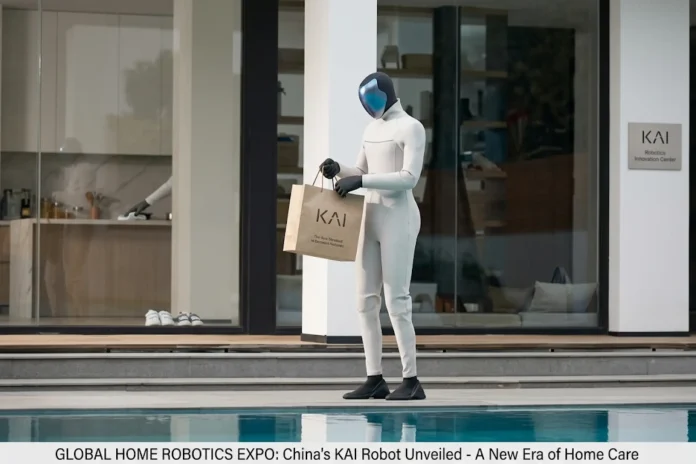
China has unveiled the KAI humanoid robot, a full-size home assistant engineered by Shenzhen startup KinetixAI to handle nanny duties, housekeeping chores, and indoor delivery tasks in a single versatile platform. The robot stands 1.73 meters tall and weighs 70 kilograms. It features 115 degrees of freedom across its body and 36 degrees of freedom in each hand, along with full-body tactile skin containing around 18,000 sensing points for enhanced touch sensitivity. Promotional materials position KAI as an affordable general-purpose solution targeting mass production pricing near or below $20,000 to $40,000, aiming to compete directly with projects such as Tesla’s Optimus.
KinetixAI, legally registered as Shenzhen Chaowei Dongli Intelligent Technology Co., introduced KAI during its “GIFTED” launch event on April 26, 2026, in Shenzhen. The company was founded by former core R&D team members from XPeng who worked on that electric vehicle maker’s Iron humanoid project. Additional team members bring experience linked to Huawei and academic backgrounds from institutions including the Hong Kong University of Science and Technology and Shanghai Jiao Tong University. Co-founder Tyler Zheng hosted portions of the event, during which a pair of KAI robots in black and white variants reportedly introduced themselves on stage. The system relies on a proprietary KAI World Model trained through a three-stage pipeline on large-scale egocentric video data captured via head-mounted multi-camera setups. This approach seeks to enable the robot to learn and adapt to new tasks from first-person human perspectives without frequent software updates or explicit reprogramming.
In the demonstration video, KAI moves through a typical family home setting with smooth, human-like gait and bimanual coordination. It gently interacts with a young child by collaboratively stacking large colorful building blocks, displaying careful proximity and patient physical engagement suitable for childcare roles. For housekeeping, the robot picks up clothing items and folds them neatly on a surface, handling soft fabrics with precise finger movements. It carries multiple shopping bags while walking stably through rooms, suggesting capability for transporting household goods or short-range delivery duties indoors. Additional segments show KAI playing table tennis, gripping a paddle and returning shots with timing and hand-eye coordination that highlight its dynamic reflexes and fine motor control. These scenes emphasize fluid transitions between unrelated tasks in a lived-in environment, supported by the robot’s hybrid dexterous hands and tactile feedback.
China’s accelerating investment in humanoid robotics reflects pressing demographic realities, including a working-age population that has contracted since 2022 and growing strains on eldercare and domestic labor. With over 140 companies now active in the sector and supportive policies for advanced manufacturing, the country is leveraging its strengths in sensors, batteries, actuators, and supply chains to scale production faster than many Western counterparts. KAI joins efforts from firms such as UBTECH and continued work at XPeng, focusing on practical home and light industrial applications where reliable physical interaction matters most. The emphasis on on-device learning and high degrees of freedom addresses limitations seen in earlier robots that relied heavily on cloud processing or narrow task scripting.
Observers note that while the promotional clips showcase impressive dexterity and adaptability in controlled conditions, real-world performance around children, long-duration autonomy, and consistent safety will require extensive independent testing. Questions remain about the extent of true on-the-fly learning versus careful staging, a common point of discussion with early humanoid demos. Even so, KAI’s positioning at a consumer-accessible price point could accelerate adoption if production timelines hold toward late 2026 or early 2027 targets. This development underscores a broader global shift toward embodied artificial intelligence, where machines increasingly share physical spaces with people not just as tools but as responsive household participants.
For more on the underlying technology and team background, see the company’s site at kinetixai.tech. Details on XPeng’s related Iron project provide useful context for the founding team’s expertise. Broader industry tracking appears through resources such as humanoid.guide.