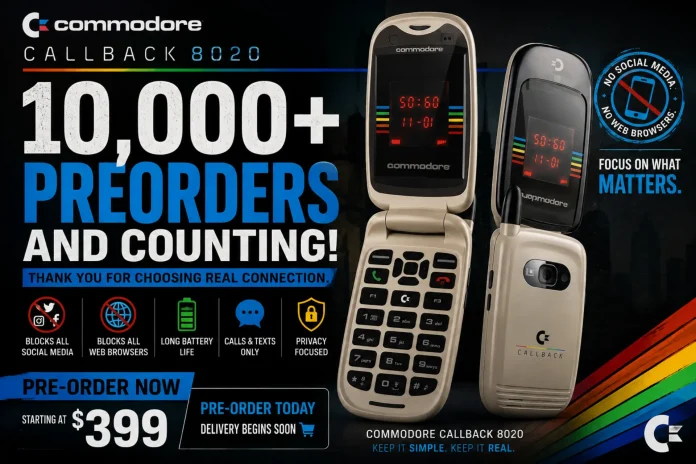
Preorders for the Commodore Callback 8020 have surpassed 10,000 units, according to company statements and independent trackers as of early August 2026. The flip phone, designed to block social media apps and web browsers at the system level, opened for preorder on June 30 at a starting price of $399, as reported in the X post reporting the 10,000-unit preorder milestone. Hypefresh previously covered our earlier coverage of the original $499 dumbphone announcement when the device was first revealed.
Commodore International Corporation, the revived brand headquartered in Dover, Delaware, first announced the device in mid-June. CEO and president Christian Simpson, known online as Peri Fractic, described the Callback 8020 as a “not dumb dumb-phone” aimed at people who want core connectivity without algorithmic feeds or constant notifications. The brand’s revival and corporate history are covered in Commodore International’s Wikipedia article.
Simpson, a British actor and host of the Retro Recipes YouTube channel, acquired the remaining Commodore trademarks in 2025. He assembled a team that includes former Commodore engineers and partnered with the Finnish company Jolla to create a custom version of Sailfish OS, a Linux-based system. The software can run more than 99 percent of Android apps through a compatibility layer while excluding social platforms, browsers, email clients, and work tools such as Slack or Teams. Background on the partnership is available in Jolla’s Wikipedia article (Sailfish OS partner) and Sailfish OS’s Wikipedia article.
Blocking is enforced through patent-pending operating-system measures, restrictions on sideloading, and DNS-level filtering, according to statements Simpson gave to outlets including Wired’s profile of the Callback 8020 and Tom’s Hardware’s announcement coverage. Supported functions include messaging apps such as WhatsApp, Signal and Telegram, maps, ride-sharing services including Uber and Lyft, music streaming, a 48-megapixel Sony rear camera, QR scanning, podcasts and FM radio. The touchscreen remains disabled by default.
The hardware centers on a MediaTek Helio G81 processor, 4 GB of RAM, 64 GB of storage expandable by microSD card, dual-SIM 4G LTE, Wi-Fi, Bluetooth and GPS. It features a 3.25-inch 480-by-640 internal display, a 1.77-inch external status screen with dome LED notifications, a removable 1,550 mAh battery, USB-C charging and a 3.5 mm headphone jack. Base models ship with post-consumer “eco-validated” memory chips; buyers can upgrade to new premium memory for an additional $50. Custom Hi-Def in-ear monitors are offered as an optional accessory. The launch comes against the broader 2026 foldable-phone market context in which Android flagships continue to dominate flagship launches.
Available colors are BASIC Beige, ProtoPET White, SX Silver, a translucent Starlight Edition and a Founders Edition that carries a 24-karat gold-plated C= key and starts at $640. The model number nods to Commodore’s 8010 modem from 1980. Shipping is targeted for the fourth quarter of 2026, with current estimates pointing to October or November.
The original $499 price drew immediate criticism. On June 24, Commodore cut the starting price of most models by $100 after customer feedback, introducing tiered options that unbundled the earphones and defaulted to recycled memory. A one-day code, CHICKENLIPS, delivered an extra $50 discount on June 30 for those who had joined the waitlist. The company said the waitlist had reached 100,000 sign-ups in the two weeks before preorders opened. Engadget’s coverage of the original launch first reported the device in June 2026, while Engadget’s coverage of the price cut covered the subsequent price reduction ahead of preorders.
Early demand proved strong. Trackers reported roughly 8,000 units sold in the first week, generating an estimated $3.1 million to $3.3 million in revenue. By July 8, Commodore indicated preorders were approaching 10,000. That threshold has since been passed.
Simpson has said the phone is intended for evenings, weekends or deliberate breaks rather than as a full-time smartphone replacement. Around the launch he stated that the modern world is defined by distractions, especially social media, and that the Callback is built to help people look up again. The company says it does not collect or monetize user data and has also pitched the device to schools looking for alternatives to unrestricted smartphones, positioning it outside the app-data-monetization landscape the Callback sidesteps.
Read Also: our earlier coverage of the original $499 dumbphone announcement
Preorders remain open on the official Commodore website. Customers are charged at checkout and may cancel for a full refund before the device ships. The company notes that final compliance testing, including U.S. FCC authorization, is still under way and that software optimization continues on pre-production units.
The early sales figures mark a measurable step for the rebooted brand, which previously concentrated on the Commodore 64 Ultimate computer. Simpson and his team present the Callback 8020 as both a practical response to digital overload and a return to Commodore’s broader history of consumer electronics that extended beyond pure computing.