

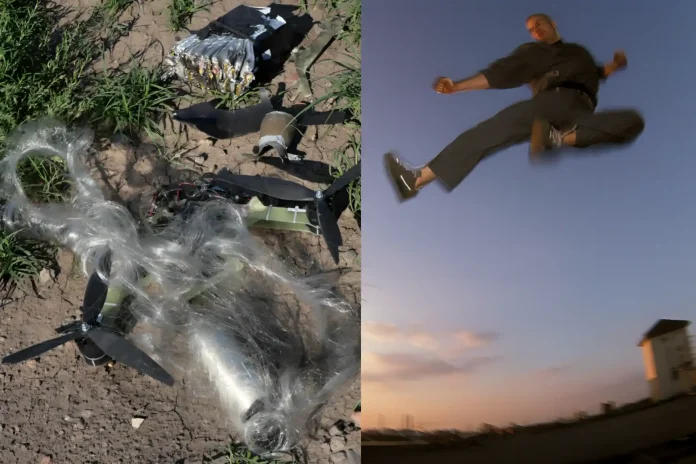
On Tuesday, August 4, 2026, late at night, a night shift bus driver working at Leipzig/Halle airport observed a flying drone around parked Ukrainian Antonov cargo planes. He stepped out of his car and kicked it off into the sky. It crashed to the ground on the apron near the southern runway.
German lawmaker Detlef Seif, a member of the Bundestag’s parliamentary interior committee, described the moment to journalists.
“A bus driver kicked the drone away while it was flying low. It then crashed and came to rest on the ground,”
Seif said.
“The bus driver’s action was very daring and courageous, but also very dangerous. It is possible that his intervention prevented the intended attack.”
Prosecutors confirmed the drone carried professional explosives and a detonator. Federal officials said the device was equipped with a fist-sized package of high-performance plastic explosives, identified in some reports as including Semtex or PETN. The detonator was defective or had failed, so the device never exploded. Bomb-disposal specialists used a robot to remove the detonator and secured the remainder.
Leipzig/Halle is no ordinary airport. It ranks among Europe’s busiest cargo hubs and serves as the main operational base for NATO’s Strategic Airlift International Solution, which relies on Antonov freighters for military logistics supporting the alliance’s eastern flank and related operations. That strategic role helps explain why federal prosecutors treated the case as a serious potential attack on critical infrastructure that could affect both domestic and foreign security.
Saxony’s Interior Minister Armin Schuster praised the driver’s courage while stressing the risk.
“But it’s not a model to be emulated. Letting us know would be enough,”
Schuster said. Federal Interior Minister Alexander Dobrindt called the episode a “new threat scenario” and a possible hybrid-attack situation.
Authorities suspended operations, closed both runways temporarily, and diverted flights. A DHL cargo plane that aborted its approach later struck an unidentified object roughly six kilometers from the airport and diverted safely to Hanover with minor damage. Investigators have not confirmed whether that object was a second drone.
The incident exposes clear gaps. The drone sat inside the secure zone for hours without triggering automated defenses, according to surveillance reviews. Modified commercial-style drones that evade sensors pose a growing challenge for airports and other critical infrastructure across Germany and Western countries. One alert worker and a failed detonator prevented a worse outcome this time. Stronger detection systems and clearer protocols will be needed as weaponized drones become a more common threat.

