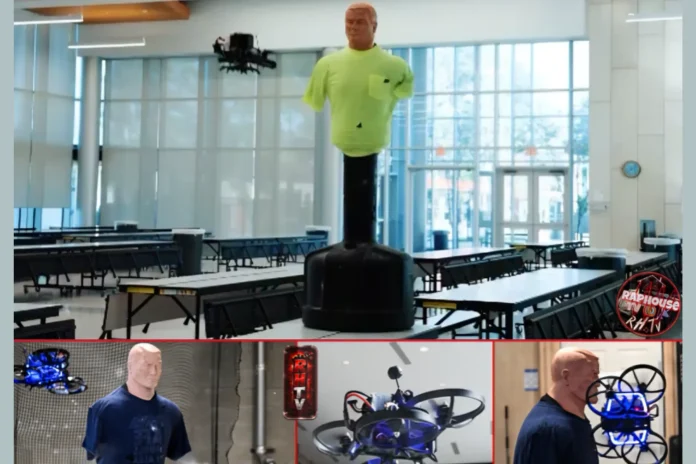
A short video circulating on X has drawn heavy attention this week. It shows a compact blue-and-black drone racing through a school cafeteria, weaving past tables and closing in on a mannequin in a neon shirt. The clip, shared by media accounts including @raphousetv2, has fueled claims that schools are already fielding flying weapons against shooters. The footage is a real product demonstration, not scenes from any actual attack. That distinction matters: the system has never been used in a real active-shooter incident.
Multiple outlets, led by The Washington Post’s July 28 report, confirm that at least nine schools in Florida, Georgia, and Colorado are preparing to install Mithril Defense’s Campus Guardian Angel system for the 2026-27 school year. Three Florida campuses (including Deltona High School, the first to install it), five in Georgia, and one self-funded charter in Colorado will house the plastic, pizza-sized drones in secure hallway boxes. Florida and Georgia each put roughly $550,000 behind their pilot programs.
Teachers or staff trigger the system with a panic button or app. Remote pilots based in Texas take control. Company officials say a drone can be airborne in about five seconds and reach a threat in roughly 15. It can flash strobes, blare sirens, spray pepper gel, open two-way communication, and, if needed, ram a target at speeds up to 60 mph or break non-ballistic glass. Justin Marston, founder and CEO of Campus Guardian Angel, has described the goal this way:
systems “that can respond to an active shooter in five seconds, confront them in 15 seconds, and degrade or incapacitate the shooter within 60 seconds.”
Co-founder Bill King, a retired Navy SEAL, has said once the drones engage,
“you just can’t escape them.”
Supporters see the technology as a way to buy time in the critical early minutes when most casualties occur. Volusia County Sheriff Mike Chitwood, whose district includes Deltona High, called it “the future.” The backdrop is stark: according to a Washington Post tracker, nearly 400,000 students have been affected by school gun violence since Columbine, across more than 400 incidents.
Critics remain unconvinced. The drones have only been tested in simulations and staged demos. School safety consultant Curtis Lavarello has voiced “really serious reservations,” warning of risks that include mistaking a fleeing student or responding officer for a threat. Tony Montalto, whose daughter Gina was killed in the 2018 Parkland shooting, has argued that resources should prioritize prevention over reaction:
“We need to focus on the prevention piece rather than the reaction piece.”
Other concerns include psychological effects on students, legal liability, privacy, and whether limited education dollars are better spent on mental health support or other measures.
This is a limited pilot program, not a national rollout. The deployments are real. The claim that these drones will reduce casualties in an actual shooting remains unproven. Readers following the conversation online are better served by the verified reporting from outlets that have examined the contracts, funding, and limitations than by any single viral clip.