

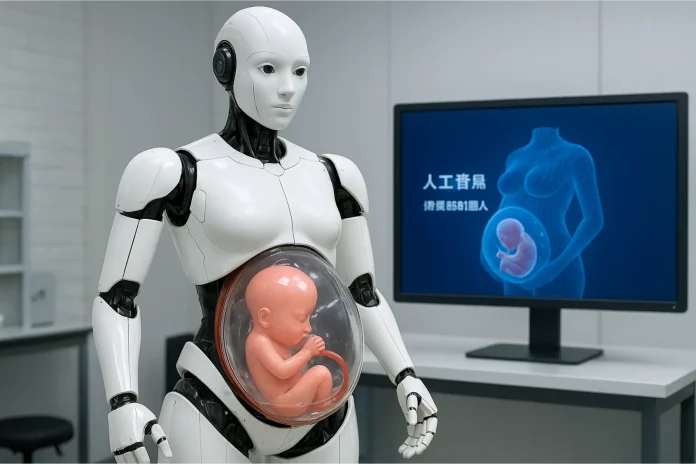
In August 2025, reports emerged from the World Robot Conference in Beijing about a company called Kaiwa Technology unveiling a revolutionary humanoid robot named GEAIR. The robot was said to feature a synthetic uterus, artificial amniotic fluid, and a nutrient delivery system, allowing it to gestate a human embryo from conception to full-term birth. Founder Zhang Qifeng reportedly claimed a prototype could be ready by 2026, priced accessibly to replace traditional surrogacy or pregnancy.
The story spread rapidly across global media, amplified by striking images of sleek robots with transparent abdomens revealing developing fetuses. It sparked debates on infertility solutions, gender roles, and reproductive ethics. However, investigations quickly uncovered the truth: no such prototype exists, institutional affiliations were denied, and many images were AI-generated.
Zhang Qifeng clarified that his remarks in an interview were edited out of context, and his Guangzhou-based company focuses on service robots, not reproductive technology. Nanyang Technological University denied any involvement. Fact-checks confirmed the claims were exaggerated or fabricated, highlighting how tech hype can fuel misinformation in an era of rapid viral spread.
The Real Science Behind Artificial Wombs
While the Chinese robot story was false, artificial womb technology—known as ectogenesis—is a legitimate field of medical research. The core theory aims to recreate the womb’s protective environment: a fluid-filled space with synthetic amniotic fluid for cushioning, oxygen and nutrient supply via umbilical-like connections, waste removal, and infection barriers to support fetal growth.
Current efforts focus on partial ectogenesis, transferring extremely premature fetuses (equivalent to 22-28 weeks in humans) to an artificial system for continued development. A landmark 2017 study utilized a “biobag”—a sealed plastic bag containing fluid and external oxygenation—to sustain premature lamb fetuses for weeks, enabling normal growth of the lungs, brain, and organs without ventilator damage.
Ongoing projects, such as the EXTEND system at the Children’s Hospital of Philadelphia and similar platforms in the Netherlands, Australia, and Japan, refine this approach. These devices function as advanced bridges from womb to world, targeting human trials possibly in the late 2020s for saving preemies, not full gestation from embryos.
How Realistic Is Full Ectogenesis?
Partial systems for preemies are progressing toward clinical use, potentially reducing mortality and disabilities from the 15 million annual premature births worldwide. Full ectogenesis—from fertilized embryo to birth—faces massive hurdles: replicating early implantation, placenta formation, hormonal signals, and immune interactions remains unsolved, with no long-term successes in animals.
Legal restrictions, like the 14-day limit on human embryo culture in many countries, including China, add barriers. Experts view the integration of humanoid robots as unnecessary complexity, offering no advantage over static medical devices. The 2025 hoax blended real robotics trends with sci-fi, but true advances prioritize evidence and safety.
Potential Benefits and Serious Risks
If partial artificial wombs succeed, they could save lives by maturing organs naturally, avoiding ventilator-related lung damage, and providing options for high-risk pregnancies. They might also enable safer fetal research and drug testing.
Hypothetical full versions could address infertility, benefit same-sex couples, or eliminate pregnancy risks, promoting equity. However, unknowns include long-term health effects, disrupted bonding, and psychological impacts from missing natural cues.
Ethical concerns loom large: commodifying reproduction, devaluing women’s roles, exacerbating inequality if costly, redefining legal viability, and evoking dystopian fears of controlled birth. Society must balance innovation with safeguards.
What Might a Baby Born This Way Be Like?
In a future with reliable full ectogenesis, a baby developed artificially might emerge physically healthy, with proper support yielding normal growth and organ function comparable to that of a natural birth. After birth, they would likely require standard newborn care and monitoring for any subtle immune or neurological differences.
Daily life can be entirely typical, featuring activities such as playing, learning, and bonding with parents through nurturing interactions. The child might grow up aware of their unique origin but otherwise indistinguishable, raised in a loving family that chose the technology for compelling reasons.
For more on the hoax, see fact-checks at Snopes and Live Science. Ongoing legitimate research details are available from Children’s Hospital of Philadelphia.

