

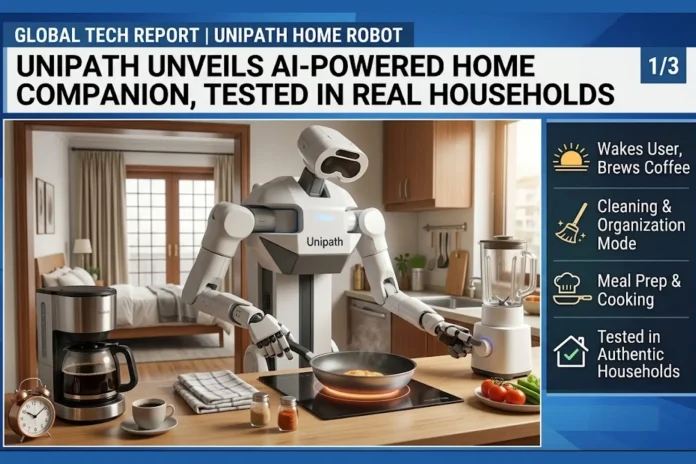
A Chinese robotics company has placed its Panther humanoid robot directly into family apartments in Suzhou where the machine now performs complete daily routines including waking residents pulling curtains preparing meals operating appliances cleaning surfaces and organizing clutter. The wheeled dual arm system from UniX AI stands about five feet three inches tall weighs roughly 176 pounds and operates for eight to 16 hours on a single charge while navigating typical home layouts with omnidirectional mobility. This marks one of the earliest real world deployments of a full size humanoid designed specifically for unstructured household environments rather than controlled laboratories or industrial settings.
The Panther relies on a sophisticated embodied AI system developed in house by UniX AI and built around a Trinity architecture that combines UniFlex for generalizable imitation learning UniTouch for visuotactile fusion sensing and UniCortex for long horizon task planning and decomposition. Onboard edge computing delivers up to 2070 TOPS of processing power enabling sub 100 millisecond latency from perception to action without constant cloud dependency. The robot features 34 high degree of freedom joints including the world first mass produced eight degree of freedom bionic arms equipped with adaptive intelligent grippers capable of lifting up to 12 kilograms while its perception suite includes RGB depth cameras microphones and optional LiDAR for precise environmental understanding and voice based interaction.
In live demonstrations captured inside occupied homes the Panther executes multi step sequences such as blending ingredients stirring food in a wok delivering plates to the table and then tidying the kitchen afterward all while responding to natural voice commands and adapting to changing conditions like cluttered counters or unexpected objects. These capabilities stem from the robot extensive training on imitation learning frameworks that allow rapid generalization to new household scenarios with minimal additional data. The design prioritizes practical reliability over pure bipedal complexity by using a stable wheeled base that moves smoothly through narrow doorways and around furniture common in Chinese apartments.
Compared with leading Western humanoid platforms the Panther rollout highlights a clear divergence in deployment strategy and commercial readiness. Tesla Optimus models emphasize end to end neural networks and versatile bipedal locomotion for both factory and future home use yet remain largely confined to internal testing and pilot programs with no equivalent scale of real household integration reported to date. Figure 03 from Figure AI demonstrates strong cognitive learning from human demonstrations and has entered enterprise pilots in manufacturing but has not reached consumer homes. Boston Dynamics electric Atlas excels in dynamic mobility and precision tasks within industrial partnerships yet commands premium pricing and remains unavailable for residential applications. Chinese firms including UniX AI have accelerated practical scaling through rapid iteration mass production and direct validation in everyday living spaces giving the Panther an immediate edge in accessible home robotics.
This early adoption of advanced embodied AI in ordinary households could reclaim significant daily time for working families and aging residents while easing routine burdens that often consume hours each week. At the same time the technology invites careful examination of long term effects on privacy data security and the evolving role of human labor in domestic services. UniX AI positions the Panther as part of a broader push toward truly capable general purpose robots that integrate seamlessly into personal lives rather than remaining experimental prototypes. Official product specifications are available on the company website while deployment footage and pilot updates appear on their LinkedIn channel and through verified video reports on YouTube.
The Panther success reflects broader momentum in Chinese robotics where companies leverage integrated supply chains and state supported innovation to move faster from concept to consumer ready systems. Western developers continue to advance foundational AI and mobility breakthroughs but face longer timelines for widespread home availability. As these platforms mature the global conversation will increasingly focus on balancing technological benefits with responsible safeguards ensuring that household robots enhance human wellbeing without unintended disruptions. For now, the Panther stands as a tangible example of embodied intelligence transitioning from vision to everyday reality inside real homes.

