

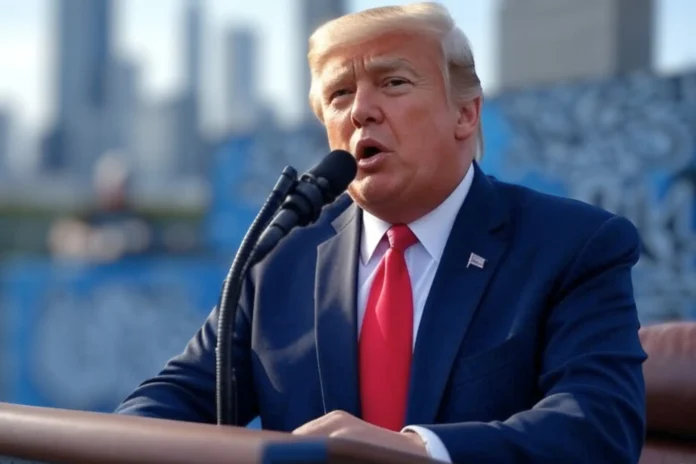
President Donald Trump’s bold declaration to bring a federal takeover to Chicago has ignited a firestorm of controversy, as the city grapples with its reputation for crime and a vibrant yet embattled hip-hop scene. Speaking from the Oval Office on August 22, 2025, Trump announced plans to target Chicago next for a federal crime intervention, following his unprecedented move to federalize Washington, D.C.’s police force. He described Chicago as “a mess” and criticized Mayor Brandon Johnson as “grossly incompetent,” claiming residents, particularly “African American ladies, beautiful ladies” wearing red hats, are pleading for his intervention.
This statement has raised eyebrows, with local leaders and residents questioning the need for federal involvement and the implications of a Trump Chicago takeover in a city already showing signs of declining crime. Trump’s plan builds on his recent D.C. operation, where he deployed 800 National Guard troops and 500 federal agents, claiming an 83% drop in carjackings and a 22% reduction in violent crime in just one week. However, Chicago’s legal landscape differs significantly from D.C.’s, as the city operates under Illinois state law, not federal home rule.
Mayor Johnson has fiercely opposed the idea, arguing that Trump lacks the authority to deploy federal forces or take over local police.
“Chicago’s constitutional rights will not be trampled by authoritarianism,”
Johnson declared, supported by Illinois Governor JB Pritzker, who emphasized that local efforts have already reduced crime. A pending federal court ruling will determine whether Trump can override state authority to deploy the National Guard, making the feasibility of a Trump Chicago takeover uncertain. Chicago’s crime statistics paint a nuanced picture.
In 2024, the city reported 118,578 total crimes, a 5% decrease from 124,241 in 2023, with violent crime dropping 6% from 29,499 to 27,694 incidents. Homicides have also declined, with Chicago recording a homicide rate of approximately 18.3 per 100,000 residents in 2024, down from higher rates in previous years. Despite these improvements, Chicago’s violent crime rate remains above the national average, driven by gang-related activity in neighborhoods like Englewood and Austin.
The city’s gang culture, involving groups like the Gangster Disciples and Black P. Stones, has long fueled its reputation as a hotspot for violence, with turf wars and retaliatory shootings dominating headlines. This gang activity is deeply intertwined with Chicago’s hip-hop scene, particularly the drill rap subgenre, which has both shaped and reflected the city’s street culture. Drill, pioneered by artists like Chief Keef and Lil Durk, often features lyrics about gang life and rivalries, sometimes escalating real-world conflicts.
A high-profile case is the 2021 murder of drill rapper FBG Duck, gunned down in Chicago’s Gold Coast in what authorities believe was a gang-related hit tied to rivalries between the Gangster Disciples and O-Block, a faction linked to Lil Durk’s Only The Family (OTF) collective. Another notable case involves the 2022 arrest of several Chicago drill artists in a federal racketeering case, accused of using their music to promote gang violence, highlighting the blurred lines between art and crime.
Trump’s proposed crackdown could have profound effects on Chicago’s hip-hop community. Increased federal presence might lead to heightened surveillance of drill rappers, whose lyrics and social media posts are already monitored by law enforcement. This could stifle artistic expression or result in arrests if authorities interpret their content as inciting violence. Conversely, the intervention could inspire a new wave of drill music, with artists using their platform to critique federal overreach, much like 1990s rappers responded to police crackdowns. Community leaders worry that federal troops could erode trust in neighborhoods already skeptical of law enforcement, potentially escalating tensions rather than resolving them.
The plan has sparked polarized reactions. Some Chicago residents, frustrated by persistent gun violence, welcome the idea of federal support, while others see Trump’s Chicago takeover plan as a political stunt targeting Democratic strongholds. Posts on X reflect this divide, with users debating whether Chicago needs “saving” or if local strategies, like community-based anti-violence programs, are sufficient. Trump’s focus on Chicago also coincides with his controversial commutation of Gangster Disciples founder Larry Hoover’s federal sentence in May 2025, following lobbying by Kanye West. While Hoover remains in state prison, his release from federal custody has stirred debate about its impact on Chicago’s gang dynamics, potentially complicating any federal intervention.
