

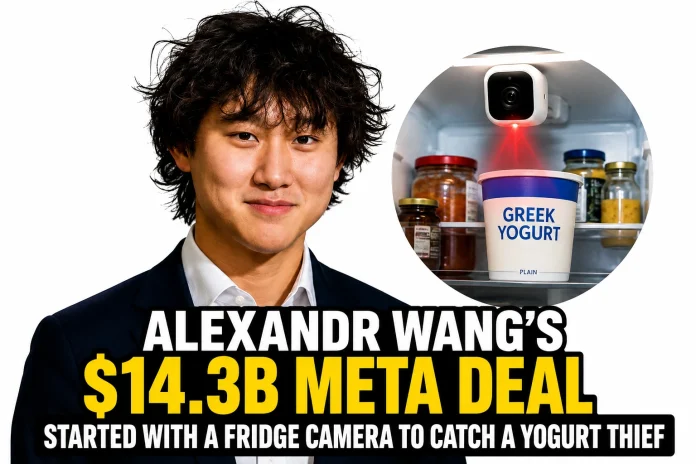
Meta Platforms has appointed Alexandr Wang as its first Chief AI Officer following a $14.3 billion investment in his data company Scale AI.
The deal, announced in June 2025, gives Meta a 49% stake in Scale AI and values the startup at roughly $29 billion. Wang stepped down as Scale’s CEO and now leads Meta Superintelligence Labs, the division overseeing the company’s artificial intelligence research and development.
In a shared MIT apartment refrigerator around 2015, yogurt kept vanishing. Alexandr Wang, then a teenage student, suspected roommates. He installed a camera, collected footage, and tried to train an AI system to identify who was reaching in and what they took. The hardware worked. The software largely did not. There simply was not enough carefully labeled training data to teach the model the difference between hands, people, and the everyday chaos of a real fridge.
That small, failed project became the spark for one of the most consequential careers in artificial intelligence. Wang dropped out of MIT at 19, co-founded Scale AI, and spent the next decade building the data infrastructure that many of the world’s leading AI systems quietly depended on.
Roots in a Scientific Town
Wang was born in January 1997 in Los Alamos, New Mexico, the same community that once housed the Manhattan Project. Both of his parents worked as physicists at Los Alamos National Laboratory. Growing up amid conversations about advanced science and computation, he developed an early and intense focus on mathematics and programming.
As a teenager he competed at high levels, qualifying for the Math Olympiad Program, the U.S. Physics Team, and the finals of the USA Computing Olympiad. Rather than remaining solely in academic contests, he moved into professional engineering roles while still in high school, working at the wealth-management firm Addepar and later at Quora. By the time he enrolled at MIT, he already had experience shipping production code.
The Data Bottleneck Revealed
At MIT, the rapid progress in deep learning—exemplified by breakthroughs such as AlphaGo—convinced Wang that artificial intelligence was accelerating faster than traditional academic timelines could accommodate. His fridge-camera experiment made the practical limitation concrete: models were only as good as the data used to train them. Researchers were refining architectures, but the hard, unglamorous work of producing large volumes of accurately annotated data remained underserved.
In 2016 he left MIT and, with Lucy Guo (a former Quora colleague), founded Scale AI through the Y Combinator accelerator. The company set out to supply the missing piece—an efficient system for delivering high-quality labeled datasets to organizations building AI applications.
Scaling the Infrastructure Layer
Scale AI first found strong demand in the autonomous-vehicle sector, where companies needed precise annotation of sensor and video data. As the field expanded into natural language processing and large language models, the company broadened its services to include the human feedback loops essential for aligning generative systems. Over time it became a key supplier to frontier labs, major technology firms, and government agencies, including work supporting U.S. defense analysis.
By 2021 a funding round valued Scale AI at $7.3 billion. Wang, then 24 and holding a significant ownership stake, was briefly recognized as the world’s youngest self-made billionaire. Subsequent growth pushed the company’s valuation higher still, reflecting its central position in the AI data supply chain.
The Meta Partnership
By mid-2025 Meta was investing heavily in computing infrastructure while seeking stronger internal execution on advanced models. In June of that year the company announced a $14.3 billion investment for a 49 percent stake in Scale AI, valuing the startup at roughly $29 billion. The transaction gave Meta preferred access to sophisticated data and evaluation capabilities while bringing Wang inside the organization.
Wang stepped down as Scale AI’s CEO, remaining on its board, and joined Meta as Chief AI Officer. He leads Meta Superintelligence Labs, the group that consolidates the company’s AI research, product, and model-development efforts under a unified push toward more capable systems. Meta CEO Mark Zuckerberg has publicly described him as one of the most impressive founders of his generation.
Looking Ahead
Wang’s role now centers on accelerating Meta’s ability to develop and deploy advanced AI across its large user base. The company’s strategy emphasizes integrating capable models into everyday products rather than treating AI solely as a standalone destination. Wang has spoken of the potential for deeply personalized systems that understand individual context and support real-world goals.
His path—from a failed attempt to catch a yogurt thief to leading AI efforts at one of the world’s largest technology companies—illustrates a simple but powerful lesson. In the current era of artificial intelligence, identifying and solving the unglamorous bottlenecks can prove as decisive as inventing the most glamorous new architectures. The camera in the fridge never identified the thief. It did, however, help reveal the data problem that shaped a company, a career, and a significant chapter in the ongoing AI race.
