

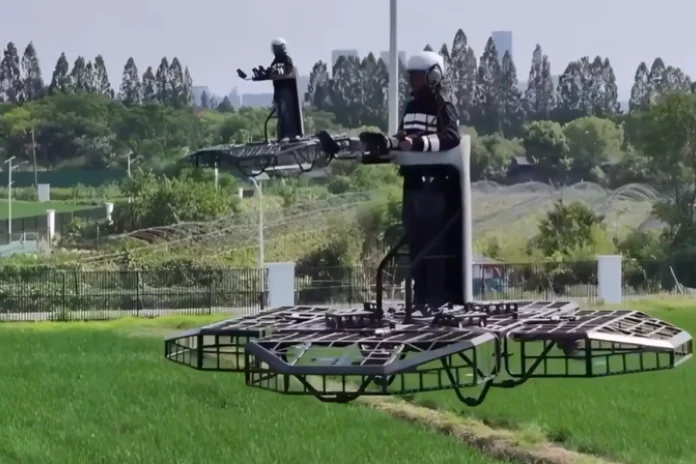
A rider stands upright on a flat, flower-shaped platform that looks like an oversized skateboard, four enclosed ducted fans humming underneath as it lifts off. No cockpit. No seat. Just the person, a control stick, and open air.
That’s the CoolFly Urban, and it’s not an AI deepfake or CGI stunt. Hangzhou-based Chinese startup CoolFly unveiled the single-person electric vertical-takeoff-and-landing aircraft at its global product launch in Hangzhou in mid-August 2026, complete with live flight demos. Multiple outlets, including Global Times and a PR Newswire release dated August 17, covered the event, and the company’s own materials confirm the design.
Urban is fully electric and built for one standing rider. The platform measures roughly 2.2 meters square in official dimensions (some reports say about 3.5 meters across). Four ducted fans sit in the outer “petal” sections behind honeycomb grilles. Sensors track shifts in the combined center of gravity of rider and machine; the proprietary NA80 dual-redundant flight-control system then adjusts thrust to keep things stable. CoolFly CEO Li Wei described the experience this way:
“The pilot simply nudges a control stick to move forward or backward and presses a button to take off. The upright stance delivers an unobstructed 360-degree view.”
Company-reported figures put payload capacity at up to 90 kg (suitable for riders up to about 1.9 meters tall), top speed around 70 km/h (about 43 mph), and flight time of roughly 11 minutes in tests with a 70 kg pilot. Actual endurance varies with weight, conditions, and flight profile. The system is dual-redundant with triple-redundant inertial measurement units in each control unit; CoolFly says it can continue flying after loss of one motor and includes a ballistic parachute option.
Two claims have spread fastest: “no pilot license required” and “learn to fly in 10 minutes.”
Li Wei told Global Times,
“It takes only about 10 minutes to get the hang of it.”
That remains a company statement. No independent testing has publicly confirmed that most ordinary people can safely operate the aircraft after a ten-minute introduction.
On licensing, CoolFly positions Urban to fit U.S. FAA Part 103 ultralight rules (and similar frameworks elsewhere). Qualifying ultralights do not require a pilot certificate, medical certificate, or airworthiness certificate. But eligibility hinges on the final empty weight, speed limits, fuel (or battery) capacity, and operating rules. Part 103 still restricts daylight operations, congested areas, airspace, and more. An empty weight near 110 kg puts it close to the U.S. threshold, yet final certification and local rules decide what is legal. The accurate version is not “anyone can fly it anywhere without a license.”
America already experimented with standing flying platforms in the 1950s most notably the Hiller VZ-1 Pawnee, a gasoline-powered ducted-fan craft. CoolFly’s version is electric, computerized, and aimed at recreation, tourism, and short low-altitude hops rather than military trials. Calling it the absolute first flying platform without that qualifier overstates the novelty.

