

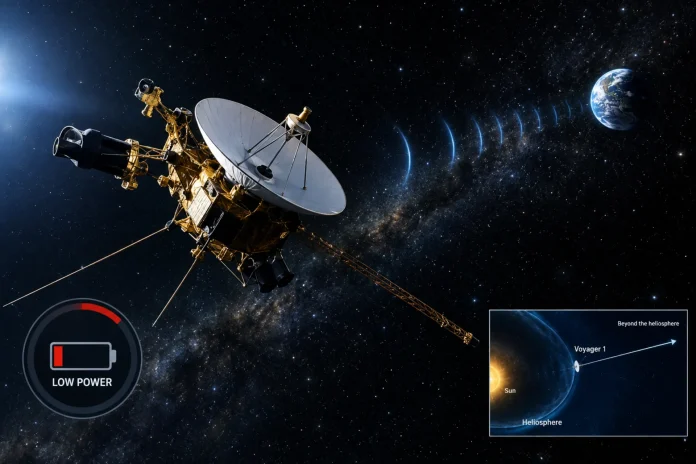
Voyager 1 and Voyager 2, NASA’s legendary twin probes launched in 1977, are the farthest human-made objects from Earth — hurtling through interstellar space — but their nuclear power is gradually fading, threatening to end their ability to send signals back to our planet.
As of September 2026, both spacecraft are still fully operational, though they’ve been forced into aggressive power-saving mode to stretch their remaining life as far as possible. Voyager 1, the current record-holder, sits about 15.8–16 billion miles (roughly 25.5–25.7 billion km) from Earth — already deep beyond the heliopause, the edge of the solar system’s influence and into the very local interstellar medium. On Nov. 18, 2026, it will cross another historic milestone: becoming the first human-made object to reach one light-day (the distance light travels in 24 hours, or 25.9 billion km). Voyager 2 trails slightly behind at over 13–14 billion miles but is heading in a different direction, both probes now on their way toward the constellation Ophiuchus.’
The power for both comes exclusively from radioisotope thermoelectric generators (RTGs) — small nuclear devices powered by plutonium-238 fuel. Each probe carries three of them, totaling about 1 kg of Pu-238 oxide per spacecraft. The alpha decay of that plutonium generates heat for nearly 49 years, which thermocouples convert into electricity. Initial output was around 470 watts per probe; today it’s down to roughly 220–225 watts, with a steady loss of about 4 watts of electrical power per year from fuel decay and thermocouple wear. No solar panels are available past 4–5 AU, so these RTGs are the only source left.
Transmission power for the Deep Space Network is now so low it’s basically just a few watts — comparable to a single hallway light bulb. To conserve what’s left, NASA engineers have had to shut down most of the original 11 science instruments on each probe. Here’s the current breakdown:
Voyager 1 (as of April 2026, with no major updates since): Only two instruments remain active — the Magnetometer (MAG) and Plasma Wave Subsystem (PWS). The Cosmic Ray Subsystem (CRS) was turned off back in February 2025, and the Low-Energy Charged Particles (LECP) followed on April 17, 2026.
Voyager 2: Still has three instruments working thanks to a clever “Big Bang” reconfiguration the team executed earlier this year. They simultaneously powered down non-essential systems and swapped in ultra-low-power alternatives, freeing up nearly 10 watts while keeping the spacecraft warm enough to stay operational. That move has already pushed the three-instrument window out by at least another year.
A minor glitch on Voyager 1 in 2025 (a corrupted flight data memory chip) was fully resolved by mid-2024 after engineers relocated code and ran rigorous tests. Backup thrusters were also reactivated in 2025 to keep the antenna precisely pointed at Earth. Data transmission is now routine but minimal — just engineering telemetry and key science packets.
The projected timeline for losing contact? The mid-2030s. NASA says that depending on how fast the power continues to drop and any further tweaks, both probes could eventually stop transmitting reliable data or go completely silent around 2032–2035. The spacecraft themselves will keep drifting outward forever — but without power, there will be no more signals reaching Earth.
Despite the dwindling energy, the Voyagers’ scientific legacy remains extraordinary. They’ve already given us the first close-up looks at Jupiter, Saturn, Uranus, and Neptune (with Voyager 2 uniquely visiting the ice giants), mapped the heliopause, and delivered unmatched insights into the interstellar medium, cosmic rays, plasma, and magnetic fields. Their 3.7-meter high-gain antennas and redundant systems have defied 49 years of brutal conditions.
The probes also carry the Golden Record — a phonograph disc with sounds, images, and greetings in 55 languages, launched as a message to any extraterrestrial intelligence. Even after power finally fades, their trajectories and archived data will keep yielding discoveries for decades.
These are engineering marvels from the 1970s that are still operating at the very edge of the solar system. NASA and the team at the Jet Propulsion Laboratory continue monitoring every move, squeezing every last watt out of the hardware. While the probes won’t return home anytime soon, their journeys continue to remind us how far humanity’s reach into space still goes — even as their power slowly runs out.

