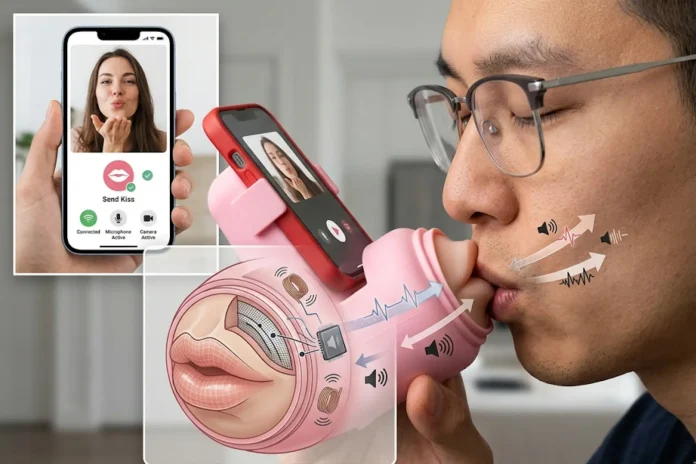
Chinese citizens gained access years ago to a simple yet inventive smartphone accessory that lets distant partners share the sensation of a kiss. The device, called MUA, features soft silicone lips mounted on a phone stand. Sensors inside capture pressure, movement, and sound from one person’s lips, then transmit that data over the internet so the paired device on the other end moves, warms slightly, and replays the audio to mimic a real kiss.
What began as a creative response to pandemic lockdowns has evolved into a symbol of how haptic technology now reaches into the most personal corners of human connection. The MUA kissing device represents an early, accessible entry point into this world of remote touch. Yet it already feels almost quaint next to today’s more sophisticated VR intimacy devices that deliver nuanced sensations across entire bodies and push the boundaries of digital closeness far beyond basic lip simulation.
Inventor Zhao Jianbo developed the MUA while studying at the Beijing Film Academy. Strict COVID restrictions kept him from seeing his girlfriend, exposing the emotional limits of video calls that offered sight and sound but no physical element. He turned that personal experience into a graduate project and later founded the Beijing startup Siweifushe. The company released the MUA on January 22, 2023, priced at roughly 38 US dollars. Each partner plugs their unit into a phone charging port, pairs the devices through a companion app, and shares kisses that feel surprisingly tangible. Within the first two weeks, the startup sold more than 3,000 units and received around 20,000 orders, showing just how deeply the idea resonated with long-distance couples.
Haptic technology has advanced rapidly since that launch. The global market for touch-based interfaces continues expanding quickly, powered by improved actuators, reduced latency, and seamless integration with virtual and augmented reality. Engineers now use piezoelectric materials, linear resonant actuators, electroactive polymers, and even magnetic systems to create precise, layered feedback instead of simple vibrations. Mid-air haptics generate sensations without any physical contact, while full-body suits and gloves translate virtual textures, pressures, and movements into felt experiences that feel increasingly lifelike. These tools already serve gaming, medical rehabilitation, automotive safety, and emotional wellness applications, making digital interactions feel more intuitive and human.
In more intimate settings, teledildonics platforms synchronize adult VR content with responsive physical toys that match on-screen actions in real time. Advanced strokers with magnetic attachments, AI-powered companions, haptic underwear, and skin-like patches stimulate erogenous zones while partners interact in richly rendered virtual spaces. Some systems incorporate biofeedback sensors that adjust intensity based on heart rate or breathing, creating a more emotionally responsive experience. Popular platforms now support thousands of haptic-enabled VR videos with seamless synchronization, turning what used to be passive viewing into deeply interactive encounters for long-distance couples.
These innovations open fresh creative possibilities. Two people separated by oceans can step together into a shared virtual garden where a hand squeeze on a haptic glove feels warm and weighted, or a light brush against an avatar’s cheek registers as soft pressure and subtle heat. Researchers have found that such shared novel experiences in virtual reality can strengthen relationship satisfaction by fostering a stronger sense of presence and mutual discovery compared to traditional video calls. The human brain often fills in the missing details, transforming imperfect digital touch into something convincingly emotional and intimate.
At the same time, the rapid growth of haptic intimacy technology raises important questions. Issues around consent in digital spaces, the privacy of intimate biometric data, and the potential for simulated closeness to sometimes reduce the drive for in-person reconnection deserve careful consideration. As the line between physical and virtual continues to blur, society will need thoughtful frameworks to ensure these tools enhance rather than replace genuine human connection.
Haptic progress also carries broader benefits beyond romance. Wearable devices already help prosthetic users regain nuanced sensation, while automotive haptics provide silent safety alerts that keep drivers focused on the road. In entertainment and professional training, full immersion reduces the detachment many feel when limited to screens alone. Looking ahead, softer skin-like interfaces, artificial intelligence that learns individual preferences, and contactless ultrasound systems point toward even more natural-feeling remote touch. What once seemed like science fiction is steadily becoming part of everyday tools for combating loneliness and deepening companionship.
The MUA and its far more advanced VR successors underscore a simple truth: humans crave touch as much as they crave sight and sound. Technology cannot yet fully replicate the rich complexity of real skin-to-skin contact, yet each new generation of haptic devices brings us noticeably closer to meaningful presence across any distance. As these innovations continue maturing through 2026 and beyond, they promise richer, more creative ways to express care, desire, and emotional connection while challenging us to navigate the ethical landscape of digital intimacy with care and imagination. The future of feeling, it seems, will be built one precise haptic pulse at a time.