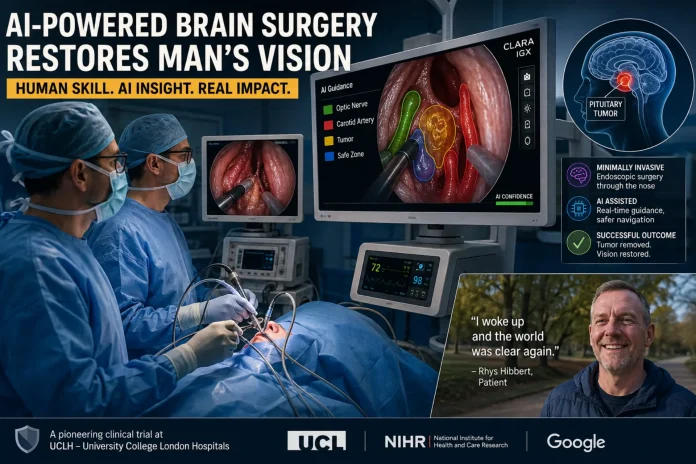
Rhys Hibbert came out of surgery with clear vision. The 48-year-old father of two, from Bedfordshire, England, had months of looking at his world through narrowing eyes because he had an 11mm benign pituitary tumor pressing against the nerves responsible for controlling his vision. Without treatment, there was a danger of becoming blind.
Hibbert fell down and had a seizure while going for a normal walk in December 2024. Tests revealed the presence of the benign growth in his pituitary gland at the bottom of his skull. His problems had increased: hormone imbalance, loss of peripheral vision, and stumbles which left him using walking sticks. Hibbert was a customer services manager and community worker who decided to take part in a clinical trial.
In May 2026, surgeons at London’s National Hospital for Neurology and Neurosurgery, part of University College London Hospitals, operated. The public only learned the details in late August after Hibbert recovered. The timing matters: the surgery happened months before the announcement.
The team used a minimally invasive approach, inserting an endoscope through the nose to reach the tumor. The pituitary sits in a cramped space next to optic nerves and major blood vessels. A millimeter-scale error can cause blindness, stroke, or death. Incomplete removal has historically been common in some series; vessel injury carries serious risk.
This time, a University College London-developed AI system watched the live endoscopic camera feed. It color-coded critical structures nerves, blood vessels, safer zones for removal and displayed the information on a second screen. Surgeons described it as a “second pair of eyes” or “surgical Google Maps.” The system, trained on hundreds of prior annotated surgical videos, tracked instruments and tissue interactions in real time. It ran on an NVIDIA Clara IGX platform designed for medical AI. Human surgeons stayed in full control at every step.
Lead surgeons were Professor Hani Marcus, consultant neurosurgeon at the hospital and professor at UCL’s Queen Square Institute of Neurology, and Mr. Danyal Khan, UCL PhD candidate and neurosurgical resident. Dr. Sophia Bano, associate professor in robotics and AI at UCL and technical lead at the Hawkes Institute, guided the technology side. The trial received support from the National Institute for Health and Care Research, with additional backing from partners including Google.
The tumor came out successfully. Hibbert reported clear vision right after waking. Within about a week he was walking independently without sticks. He later described regaining a “360-degree panoramic view.” He has returned to work and his daily walks while continuing recovery.
Headlines suggesting “AI performed brain surgery” mislead. This was assistive technology, not autonomous action. One successful case does not prove the approach is universally safer. Larger trials, regulatory review, and broader evidence on safety and effectiveness are still required. The team is already planning the next steps.
For patients facing delicate brain procedures, tools that surface hidden anatomy in real time could eventually reduce risk. American and global medicine will watch closely as the technology moves from a single pioneering case toward wider testing. For now, it remains an emerging assistant one that still depends entirely on skilled human hands.