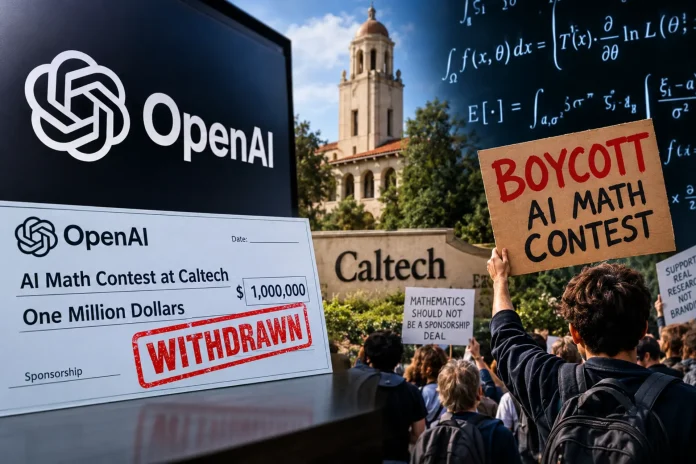
OpenAI withdrew its $1 million sponsorship of the student-run Caltech Mathathon on September 10, 2026, hours after an open letter signed by 771 mathematicians called the event destructive and labeled its approach “slop mathematics.”
The letter, circulated by current and former Caltech mathematicians starting September 8 and published that Thursday, argued the contest would flood the field with hastily produced AI-generated results that other researchers would then have to verify without credit or compensation. Signatories accused AI companies of treating research mathematics as an advertising opportunity and engaging in research misconduct.
Dan Roberts, an OpenAI research lead, announced the decision on X. “We recognize that the rapid progress of AI in mathematics is disruptive,” he wrote. “We’re looking to engage with the math community more on the best way to integrate this technology and communicate its impacts. After considering concerns raised by members of the mathematics community, we’ve decided to withdraw OpenAI’s sponsorship of the Caltech Mathathon and have notified the organizers.”
The Mathathon was announced on September 4 by a group of Caltech undergraduates. Organizers planned 100 teams to spend 40 hours tackling open research problems with large language models, each receiving roughly $20,000 in AI credits. OpenAI and Anthropic had each committed $1 million in computing credits, bringing the total to $2 million. Other backers included DARPA’s expMath program, a16z, Y Combinator and Cognition.
Caiman Moreno-Earle, a 19-year-old Caltech sophomore who helped launch the event, said the idea grew from frustration that students lacked access to frontier models. In a Zoom call with Anthropic representatives, he requested $1 million expecting far less. The company agreed, and OpenAI soon matched the offer. “This was no longer something that was just a fun little experiment,” Moreno-Earle told Business Insider.
Fellow organizers included Alvan Arulandu, Sathvik Rodrothu, Avni Garg and Brian Zhao, all Caltech students. The group described the contest as the first hackathon devoted to research-level mathematics and said it aimed to explore responsible AI use while democratizing access to powerful tools.
The open letter rejected that framing. It objected to language on the event website asking, “What is the role of a mathematician when AI can solve conjectures faster?” Signatories called the claim both motivated and empirically dubious. They warned that undergraduate participants might lack the expertise to verify results carefully and that the format would exploit early-career mathematicians. “Rather than offering an opportunity for fruitful scientific collaboration, this event exploits mathematicians at the very beginning of their careers,” the letter stated.
Yujin Kim, a postdoctoral fellow in Princeton’s mathematics department and a critic of the original plan, said the $2 million sponsorship from companies the community viewed as disrespectful to the field was “pretty outrageous.” “That’s not the culture of mathematics. That’s not how we operate,” Kim told EdSource.
The organizers published a response the same day as the letter. They removed the contested website language, made arXiv preprint publication an explicit requirement for the verification period, and expanded an educational track focused on explaining existing theorems. They declined to cancel the event. By September 10 they reported more than 1,000 applications from undergraduates, Ph.D. students, postdocs and faculty.
Anthropic did not withdraw its support. Later reports indicated the company adjusted its commitment downward in some accounts, while organizers sought additional partners to replace OpenAI’s share of the credits. The event, originally set for October 30 to November 1 at the California Institute of Technology in Pasadena, continued under revised rules that shifted some emphasis toward alternative proofs of existing results and open-source tools.
The controversy unfolded against a backdrop of broader tension. Days earlier, OpenAI had announced an AI-generated solution to a long-standing problem related to the Navier-Stokes equations, one of the Clay Mathematics Institute’s Millennium Prize problems. Mathematicians including Tristan Buckmaster of New York University had been working on related questions, and the timing and communication of OpenAI’s claim fueled accusations that companies were scooping results and offloading verification work.
Faculty advisors later associated with the redesigned Mathathon included Sergei Gukov and Tony Yue Yu of Caltech and Fields Medalist Terence Tao. A subsequent joint statement involving original organizers and some letter coauthors described the event as centered on the question of how AI can augment human understanding of mathematics. Sponsors shifted toward entities such as the Foundation for Science and AI Research and XTX Markets, with an emphasis on open-source models and travel support for participants.
As of late September, the student organizers said they wanted an event that united rather than divided the community. Brian Zhao, a junior studying applied mathematics at Caltech, told EdSource the group had redesigned the competition after hearing the concerns. The Mathathon remains a registered student organization whose decisions are made by enrolled Caltech students who receive no monetary compensation from the event or its sponsors.