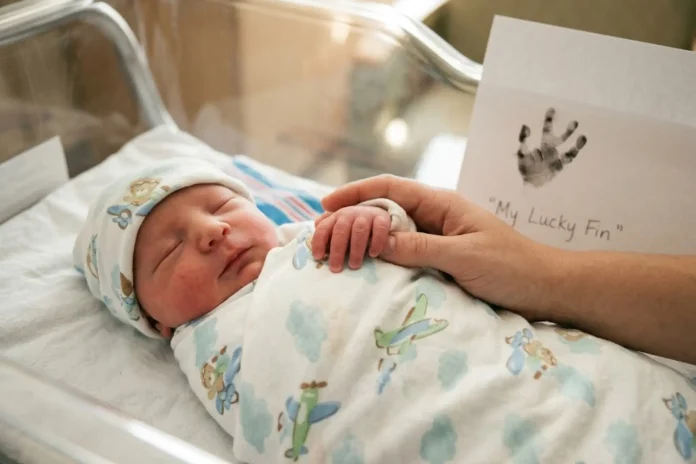
A newborn named Ronan has drawn widespread attention online after photos of his right hand circulated through the Lucky Fin Project and accounts including Complex. His mother, Claire, described a missing digit and webbing between the fingers.
Claire wrote that she and her husband learned at 20 weeks of pregnancy that Ronan would be born with a limb difference affecting his right hand. Doctors initially told them he was missing a finger. Additional ultrasounds, an amniocentesis, and genetic bloodwork from both parents indicated the difference was isolated and that Ronan was otherwise healthy, according to the account shared by the organization.
“We were relieved to find out that this is an isolated birth defect and our little guy is perfectly healthy otherwise,”
Claire wrote.
After the birth, the family observed both the missing digit and syndactyly, the medical term for webbing of the fingers.
“We are absolutely in love with how unique our boy really is, and cannot wait to see how he grows and adapts to the world with his ‘lucky fin,'”
Claire said in the post.
The phrase “lucky fin” refers to the smaller fin of the character Nemo in the film Finding Nemo. The Lucky Fin Project, a Michigan-based 501(c)(3) nonprofit, uses the term for children born with upper-limb differences. Founder Molly Stapelman launched the effort in 2010 after her daughter Ryan was born in 2007 with symbrachydactyly, a condition marked by short or underdeveloped fingers that can include missing digits and syndactyly, according to its website. The group connects families, shares medical resources, and supports camps and related efforts. Its guidance for parents also answers a question families often quietly carry: the difference
“is not caused by anything the mother did or did not do while she was pregnant.”
Posts that amplified Claire’s account described Ronan’s difference as symbrachydactyly and stated it occurs in roughly 1 in 30,000 to 40,000 births. Peer-reviewed estimates in the hand-surgery literature range from about 0.3 to 0.6 per 10,000 live births, roughly 1 in 16,700 to 1 in 33,000, so even the rarity figures tell slightly different stories depending on the source. The condition is typically unilateral, not inherited, and thought to result from a disruption in blood flow to the developing limb. Among unilateral cases, the right hand is involved only about 27 percent of the time, with the left accounting for roughly 67 percent, and it is documented predominantly in boys. Syndactyly on its own, by comparison, occurs in about 1 in 2,000 births. The condition can appear with or without associated syndromes such as Poland syndrome.
The Lucky Fin Project first shared Claire’s statement and photos on Instagram on April 23, 2026. The images show Ronan as a newborn in a hospital bassinet beside a handprint card, along with close views of his right hand held next to an adult hand. Accounts including Pubity and Complex recirculated the material in mid-May, prompting comments from parents describing similar differences in their own children, according to the posts.
Ronan is the latest in a run of rare-birth stories that have drawn large audiences by ending in celebration rather than alarm. Hypefresh tracked a 21-week-gestation birth that defied survival odds to reach a first birthday, and an Ohio infant born from an embryo frozen since 1994. The Lucky Fin Project has spent 16 years working toward exactly that framing, turning a phrase borrowed from a cartoon fish into a support network, a set of medical resources, and camps for limb-different children.
Language matters in that work. The National Center on Disability and Journalism’s style guide identifies “limb difference” as the preferred phrasing for conditions in which fingers or limbs are missing or formed differently, and it advises reporters to avoid words like “defect” when describing a specific person, in favor of naming the condition. The family’s own words set the tone here: Ronan’s introduction to the public came with a handprint card, a nickname, and a mother writing about how he will grow and adapt.
Stapelman has said a child born with a limb difference is not tragic and that treating children as limited would be the greater harm. The organization, based in the Detroit area, continues to distribute awareness materials to hospitals and to maintain a network for families navigating congenital limb differences.