

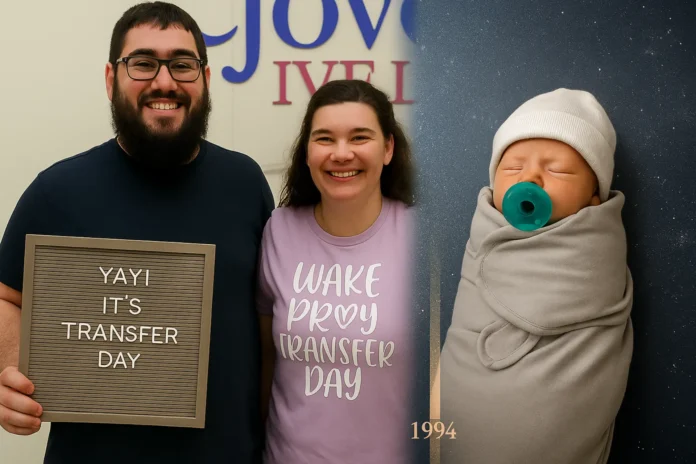
A newborn in Ohio has just rewritten history, born from an embryo frozen for over 30 years, a story that feels like it leapt from the pages of a science novel. Thaddeus Daniel Pierce, welcomed by Lindsey and Tim Pierce in London, Ohio, on July 26, 2025, may be the “world’s oldest baby,” his embryo preserved since 1994. This astonishing birth, blending cutting-edge science with a deeply personal adoption journey, has doctors marveling and ethicists debating.
A Miracle Three Decades in the Making
Lindsey Pierce, 35, and Tim Pierce, 34, endured seven years of infertility before finding hope through the Snowflakes program, a branch of Nightlight Christian Adoptions that connects couples with donated embryos. Their path crossed with Linda Archerd, 62, who created four embryos in 1994 using in vitro fertilization (IVF), a technology still in its infancy back then. One embryo became her daughter, now 30 and a mother herself, while the other three sat frozen in liquid nitrogen, costing Archerd about $1,000 a year to maintain.
After her divorce, Archerd refused to discard the embryos, believing they deserved a chance at life. She chose an open adoption, wanting to know the child and the family who would raise them. The Pierces, whose values aligned with hers, were selected. In November 2024, two of the three donated embryos were thawed and transferred at Rejoice Fertility in Knoxville, Tennessee. One embryo thrived, and Thaddeus was born healthy at term. Lindsey described the delivery as tough but joyful, saying their church community was stunned, calling it a “sci-fi miracle.”
Science Defies Time
Doctors are buzzing about this record-breaking birth, which proves embryos can remain viable for decades. Dr. Alok Patel, a pediatrician and medical expert, says a properly frozen embryo, if it passes screening after thawing, carries no added risks despite its age. “It’s as good as one created today,” he explains, pointing to Thaddeus’s healthy birth as evidence. The 1994 embryo was slow-frozen, a standard method then, but newer techniques like vitrification, common since 2000, have boosted thawing success rates.
A post from X.
The process was a logistical feat. The embryos traveled from Oregon to Tennessee, with clinic staff sifting through 1994 paper records for verification. One of the three embryos didn’t survive thawing, but two were transferred, and one became Thaddeus. This success reflects the rise of assisted reproductive technologies (ART), now behind 2-3% of U.S. births, a share growing as overall birth rates fall, per CDC data. But access to ART varies widely, limited by state laws, insurance gaps, and steep costs, raising questions about who gets to benefit from such breakthroughs.
Tough Questions Surface
Thaddeus’s birth isn’t just a scientific win; it’s a spark for heated ethical debates. With about 1.5 million frozen embryos stored in the U.S., their future is a pressing issue. Should they be treated as human life with legal rights, as states like Alabama have ruled? Archerd’s choice to preserve her embryos, driven by her belief in their potential, aligns with groups like Snowflakes, which sees embryo adoption as a way to “save lives.” Her open adoption, allowing her to receive photos of Thaddeus, shows the emotional stakes for donors.
Unused embryos face three paths: adoption, research, or destruction, each fraught with moral weight. Some advocate research to push science forward; others oppose destroying embryos outright. Storage itself is costly, about $1,000 a year, and the energy needed for liquid nitrogen tanks adds environmental concerns. Dr. Patel calls this a crossroads of biology, technology, and ethics, urging open dialogue to shape fair policies. Recent legal shifts, like Alabama’s 2024 ruling granting embryos child status, have upended IVF clinics, highlighting the need for clear rules.
A New Record, A New Era
Thaddeus’s birth, from an embryo stored for 11,148 days, tops the 2022 record of twins born from embryos frozen for 10,905 days. It shows how far fertility science has come and hints at what’s next as storage methods improve. With IVF demand rising, older embryos may become more common, but the ethical and legal terrain remains tricky, varying by state and fueling debate.
For the Pierces, Thaddeus is a hard-won blessing, a symbol of grit and hope. For Archerd, he’s a living tie to her past, a child she’ll follow from a distance.
