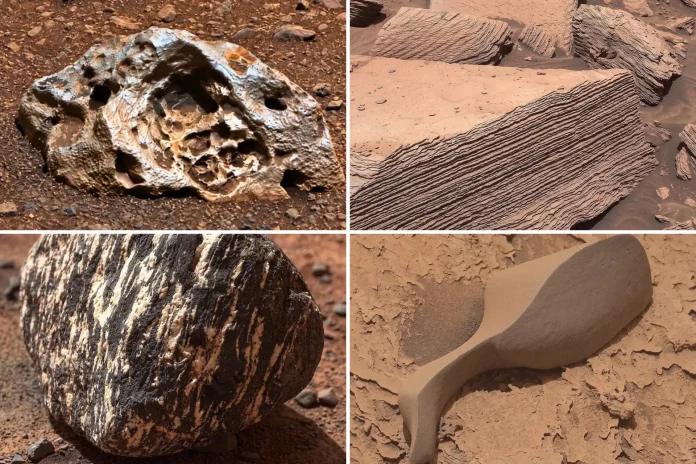
NASA’s Mars rovers keep finding rocks that look like they belong on another planet and some of their latest photographs are giving scientists plenty to investigate. From thin formations resembling potato chips to ghostly white stones and enormous honeycomb-like patterns, the Red Planet is revealing an extraordinary collection of geological features.
These discoveries have recently gained new prominence as well, having been shared by Complex on X, on November 28, 2026, with nine images from NASA rovers featuring unusual textures, cavities, layers of rocks and rocks of unusual color. These pictures are authentic NASA imagery, however, they refer to different discoveries.
One particularly unusual find came from NASA’s Curiosity rover at the Nazca drilling site on Mount Sharp, inside Gale Crater. On November 7, 2026, Curiosity’s Mars Hand Lens Imager (MAHLI) photographed thin, flattened crystal-like formations embedded in the bedrock.
NASA’s November 11 mission update, titled Rocks and Chips, described them as “disk-shaped (or, in a liberal interpretation, potato chip shaped)” crystal forms. The team collected drilling material for its onboard Sample Analysis at Mars (SAM) laboratory to investigate their chemical composition and formation conditions.
Meanwhile, NASA’s Perseverance rover discovered another striking feature around Idubi, in the Lac de Charmes region outside Jezero Crater. Its November 16 update confirmed that unusually bright rocks contain hydrated silica, a mineral associated with environments involving water.
NASA researcher Candice Bedford explained that hydrated silica has “remarkable capacity to preserve microfossils.” That makes the discovery scientifically interesting because similar deposits on Earth can preserve microscopic evidence of ancient organisms. However, no Martian fossils or signs of life have been confirmed.
In addition, Curiosity captured images of polygons with ridges forming patterns of what seems to be a huge honeycomb on Mount Sharp. According to the 17 November update from NASA, The Return of the Polygons, the causes of such phenomena might be linked to contraction of minerals because of water evaporation, temperature changes, and compaction or expansion of underground sediments.
The nine pictures provided by Complex show some other strange structures such as porous rocks, layers of sedimentary stones, dark-and-light striped stones, branched structures, rounded rocks, and crystals-covered formations. Some look like fossils, plants, or metal artifacts, but just appearance cannot prove their origin.
The rover Curiosity landed on Mars in August 2012 and explored Gale Crater, and the rover Perseverance has been working in Jezero Crater since February 2021. Cameras, lasers, and onboard laboratories help the researchers examine rock formation and minerals, investigate the traces of water existence.
Once Mars had rivers, lakes, and groundwater systems. Studying how these systems disappeared can give an opportunity to find out whether there were conditions that might support microbial life billions of years ago.
However, what makes the key difference here is the fact that the photos are legitimate, while the processes of the formation of some of the features have yet to be studied thoroughly. There has been no proven claim that these rocks are either extraterrestrial life forms or any kind of fossils.
To all the enthusiasts of Mars exploration, these photos are far more useful than any speculative material going viral on the Internet.