

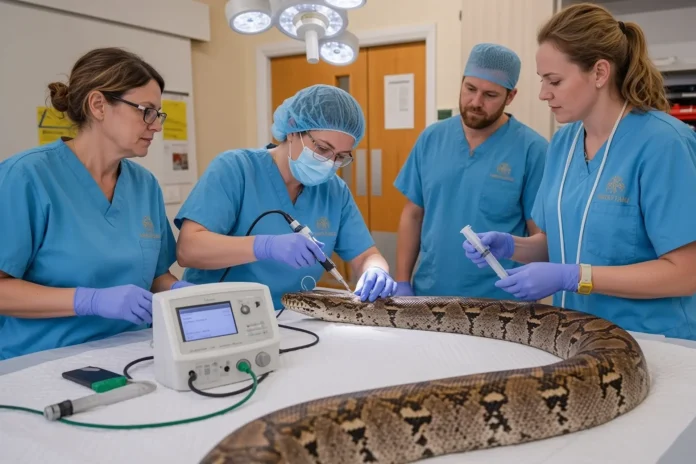
A 15-foot reticulated python named Jodie Foster has become the first snake known to receive electrochemotherapy, a cancer treatment normally used in people, and is now cancer-free at Chester Zoo in Cheshire, England — a story covered by The Guardian as a global veterinary first.
The 23-year-old, 50-kilogram snake developed a recurring fibrosarcoma in her jaw that began invading the bone and made eating increasingly difficult. Keepers first noticed reduced appetite and lower activity levels. Initial surgery in 2024 removed the malignant tumor, but it returned the following year.
Veterinary officer Ian Ashpole of Chester Zoo said the team faced the real possibility of losing her.
“When the tumour came back and started destroying part of her jawbone, we knew more surgery on its own probably wasn’t going to be enough,”
he said.
“We were facing the possibility of losing her as the tumour made it more and more difficult for her to eat, so we worked with cancer specialists to see whether we could adapt electrochemotherapy for a snake. As far as we’re aware, this is the first time it’s ever been used in one.”
Ashpole, a European Veterinary Specialist in Zoo Health Management who graduated from the University of Liverpool in 2008 and became a diplomate of the European College of Zoological Medicine in 2021, collaborated with Jose Alvarez Picornell of the university’s Department of Small Animal Clinical Science. Electrochemotherapy had previously been applied to similar tumors in cats, dogs and at least one other reptile species, but never in a snake.
The logistics alone required improvisation. Jodie was anesthetized inside her habitat before staff carefully carried her to the zoo’s veterinary centre. No single operating table was large enough, so two were pushed together to create a platform roughly the size of a double bed. Heated blankets and warmed air kept her body temperature stable throughout the 90-minute procedure — a setup that mirrors the kind of creative improvisation seen in Dagmar Turner’s awake-brain violin surgery.
Ashpole removed the tumorous mass and performed a hemi-mandibulectomy, taking out the diseased portion of her jawbone. Then the team administered the chemotherapy drug bleomycin and delivered carefully controlled electrical pulses directly to the site — a cancer-treatment approach that has previously saved Sugar, a surfing dog diagnosed with cancer. The pulses temporarily make cancer cells more permeable so the drug can enter more effectively, allowing a lower dose to be used, often in a single treatment.
“After 90 minutes of surgery, she recovered remarkably quickly,”
Ashpole said. Alvarez Picornell called the outcome “a testament to the power of collaboration” and said details of the procedure will be formally published so veterinary colleagues worldwide can learn from the approach.
Months later, a recent check-up confirmed Jodie remains free of any signs of cancer. Her appetite has returned to normal. Zoo footage shows her eating a whole chicken. Despite the partial loss of jawbone, she continues to strike, grip and swallow prey without difficulty. Pythons can unhinge their jaws to consume animals many times the size of their heads, and that ability remains intact.
Staff describe her as back to her usual bright and feisty self, exploring her habitat and behaving exactly as expected. Ashpole noted that a few months earlier they genuinely did not know whether she would survive. The case also underscores how veterinary medicine continues to adapt human treatments for exotic species, joining a growing roster of British medical firsts that include a UK baby born via deceased-donor womb transplant.
Read Also: Louisiana Man Functionally Cured of Sickle Cell Disease via Gene Therapy
“One day we’re treating a tiny frog that weighs just a few grams, the next we’re carrying a 15-foot python into theatre,”
he said.
“That’s what makes this job so interesting and fun.”
Jodie received her name shortly after arriving at Chester Zoo about two decades ago. Her paperwork was marked “JF” for juvenile female, and keepers decided the initials suited the Oscar-winning actress Jodie Foster, whose biography Britannica has documented since the late 1970s.
Chester Zoo, located in Upton-by-chester, is one of the United Kingdom’s largest zoos and operates as a conservation charity. The successful treatment of its long-term resident adds a documented first to the growing use of electrochemotherapy beyond human and domestic animal patients.

