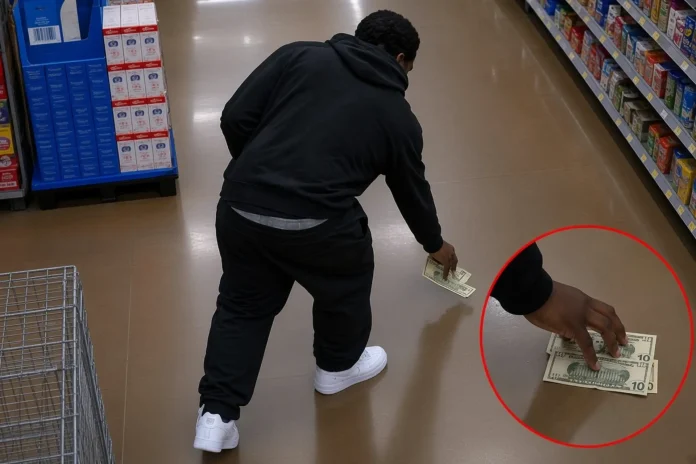
Albany Police Department is asking the public to help identify a man who picked up $30 dropped by another shopper inside a local Walmart and walked away without turning the cash over to employees.
The department posted a surveillance photo on its official Albany Police Department Facebook page around August 19, 2026, showing the man inside the store at 2586 N. Slappey Blvd. Officers described the sequence simply: one shopper dropped the money on the floor while shopping. The man in the image bent down, collected the bills, and left without notifying staff.
Anyone with information is asked to call Albany Police at 229-431-2100. The post itself did not name possible charges or confirm whether the original owner has come forward.
Under Georgia Code § 16-8-6, the theft-of-lost-or-mislaid-property statute, a person commits theft of lost or mislaid property when they take control of something they know or learn is lost or mislaid and keep it without first making reasonable efforts to return it to the owner. For property valued at $1,500 or less the offense is a misdemeanor that can carry up to 12 months in jail and a $1,000 fine. The $30 in this case falls squarely in that range.
Read Also: Florida Man Pulls Millions in Cash from Ocean, Immediately Calls Police
Police have not said whether they view the man’s actions as meeting the legal threshold. The statute requires knowledge that the property belonged to someone else and a failure to take reasonable steps such as handing it to store employees. Surveillance footage is the primary evidence cited so far.
Public reaction on the department’s Facebook post and across social media quickly focused on the ethics rather than the letter of the law, with Moneywise and Yahoo Finance both flagging the case as a textbook example of how a small amount of cash can cross the line from impulse to misdemeanor. Commenters repeatedly invoked “finders keepers,” calling the request for tips a waste of resources and questioning why officers were pursuing $30 while other crimes go unsolved — a familiar complaint from Atlanta’s recent Nike shoplifting arrest, which highlighted the same rising retail-theft tensions. One wrote that the man probably considered the cash a small blessing. Others noted they would have done the same and that turning money in to a big retailer often means it never reaches the original owner.
The episode sits at an uncomfortable intersection of everyday human behavior and formal legal duty. Most people who find a small amount of cash on a store floor do not pause to locate the loser — and Georgia courts have seen the same instinct play out before, including a 2004 arrest of a Georgia woman who tried to use a fake $1 million bill at a Walmart. The instinct is pragmatic: the money is already lost to its owner, the finder needs it more, and the effort of reporting it feels disproportionate. Georgia law rejects that calculus. It treats the decision to keep the cash, once the finder understands it is not abandoned, as an act of appropriation that triggers criminal liability.
That tension is what makes the story unusual. The amount is trivial. The location is ordinary. The alleged offender remains unnamed and uncharged, and the request for tips echoes a separate Walmart shoplifting accusation that escalated into police violence in Mississippi. Yet the official request for identification has forced a public conversation about where personal ethics end and legal obligation begins. In a store filled with cameras, the act of bending down to pick up bills becomes a permanent record that can later be measured against a statute most shoppers have never read.
No further details about the original dropper of the money or any subsequent recovery have been released. The man in the hoodie has not been publicly identified. Until someone comes forward or additional evidence surfaces, the case remains an open request for help rather than an active prosecution. It continues to surface the quiet question many people ask themselves when they spot cash on the ground — the same camera-on-shopper tension captured when a Walmart shopper confronted TikTok pranksters during the holiday rush: is keeping it wrong, or is reporting it simply more trouble than the law expects?