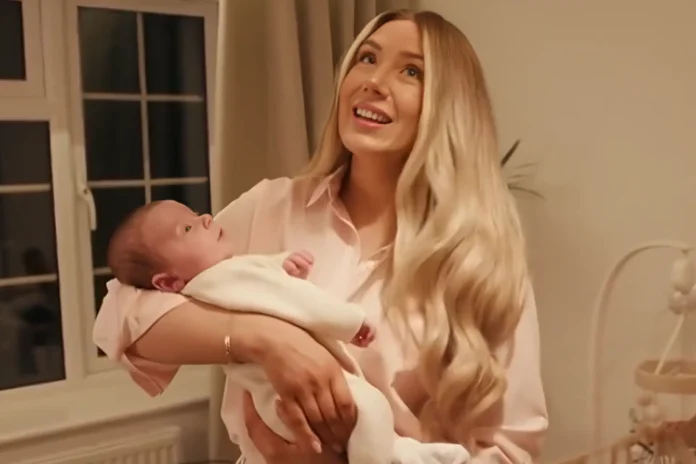
A little boy named Hugo Richard Norman Powell came into the world just before Christmas 2025, and right from that first breath he was already making history. Weighing a perfect 6 lb 13 oz (3.09 kg), he was delivered by C-section at Queen Charlotte’s and Chelsea Hospital in London. His mum, Grace Bell an IT programme manager from Kent finally got to hold the baby she once thought she’d never be able to carry herself.
Grace was born with Mayer-Rokitansky-Küster-Hauser syndrome, or MRKH. It’s rare roughly one in every 5,000 women and it means she was born without a working womb, even though her ovaries are completely normal. She found out at 16, and for years it felt like biological motherhood was off the table.
Then, in June 2024, came the turning point. Grace went through a gruelling 10-hour womb transplant at Churchill Hospital in Oxford. The uterus came from a deceased donor whose family made the extraordinary decision to go beyond standard organ donation and give this extra consent. A few months later she had IVF at the Lister Fertility Clinic in London, using her own eggs and sperm from her partner, Steve Powell. One embryo transfer later, the pregnancy took hold and everything progressed beautifully under careful monitoring.
Hugo’s arrival is a massive UK first: the very first baby born here after a womb transplant from a deceased donor. It’s only the second womb-transplant birth in the whole country (the first came earlier in 2025 from a living donor). Experts think it’s just the third successful deceased-donor case in Europe. The whole thing is part of the INSITU research programme run by the charity Womb Transplant UK. They’re planning up to 10 of these procedures, and crucially the charity covers every single cost so the NHS doesn’t have to pick up the tab.
Grace has spoken so movingly about it all.
“I think of my donor and her family every day,”
She said,
“and pray they find some peace in knowing their daughter gave me the biggest gift: the gift of life. A part of her will live on forever.”
The donor’s family, who’ve chosen to stay anonymous, released a statement full of quiet pride: their daughter also donated other organs that saved lives, and now her womb has created new life too. They called it a legacy of compassion, courage and love.
It’s easy to forget how far we’ve come. The world’s first successful uterus-transplant birth was in Sweden in 2014 (living donor). Brazil had the first from a deceased donor in 2017. Altogether more than 100 transplants worldwide have now brought over 70 healthy babies into the world. The UK programme is deliberately focusing on deceased donors to spare living ones any risk a thoughtful choice.
Of course, whenever something this new and emotional comes along, people talk. Some wonder whether operating theatres and specialist teams should be saved for life-saving transplants rather than fertility ones. Others raise the usual questions around IVF and embryo loss, or point out that surrogacy and adoption are already there. Especially looking across the Atlantic, where thousands of women face the same uterine-factor infertility from MRKH, after cancer treatment, or for other reasons this British milestone quietly opens the door to fresh conversations about what biological motherhood could look like one day.
For now, though, it’s still a tightly controlled research trial, not routine care, and every single step needed that special extra consent from the donor’s family.
Grace and Steve are still deciding about a possible second child. Once they’re done, the transplanted womb will be removed anyway standard practice to avoid years of heavy immunosuppressant drugs.
In the meantime they’re just getting on with being new parents, marvelling at their little boy who’s already being called a miracle by everyone who knows the story. And for the thousands of women who’ve been told the same heartbreaking news Grace heard at 16, Hugo’s arrival feels like a quiet, powerful message: hope isn’t finished yet. One family’s generosity in the UK might just help families an ocean away dream the same dream one day.