

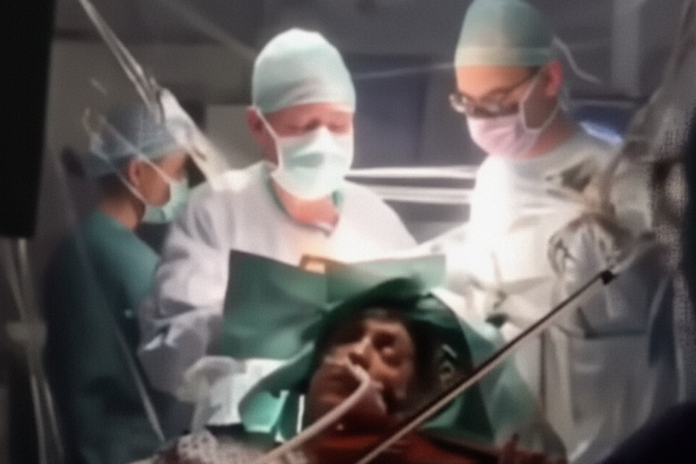
Imagine holding your instrument steady as the melody flows, even with your skull open and surgeons mapping the fragile wires of your mind, all to safeguard the music that defines you.
In January 2020, British violinist Dagmar Turner faced that exact moment during a delicate operation at King’s College Hospital in London. Diagnosed with a slow-growing tumor in her right frontal lobe seven years earlier, Turner had built her life around the violin since childhood. The growth threatened the precise hand movements she relied on for every note, turning a routine rehearsal seizure in 2013 into a wake-up call that reshaped her world.
By late 2019, scans showed the tumor stirring again, pressing closer to the brain areas that control her left-hand finesse on the strings. Turner, then 53 and a dedicated Isle of Wight Symphony Orchestra performer, knew losing that skill would shatter more than her career. It would silence the passion that grounded her as a mother and a professional who had traded consulting for full-time music.
Her surgical team, led by neurosurgeon Professor Keyoumars Ashkan, a pianist, crafted a plan rooted in empathy and precision. They opted for an awake craniotomy, a technique where the patient stays conscious for key stages to allow real-time testing of vital functions. Midway through, with the incision made and anesthesia lightened, Turner lifted her violin and played scales and excerpts from pieces like Tchaikovsky’s concerto. Each bow stroke and finger shift helped the surgeons use electrical probes to chart safe paths around her motor regions, ensuring they could remove over 90 percent of the tumor without touching her artistry.
The room hummed with focus: monitors beeped, Turner’s notes rose clear and controlled, and the team paused at any hint of disruption to adjust.
“It was vital we preserved those delicate areas,”
Ashkan later reflected, underscoring how her performance turned abstract brain maps into living guides. Three days after the procedure, Turner walked out, violin in hand, and within weeks, she rejoined rehearsals, her touch as sure as ever.
Fast forward to summer 2023, and Turner reunited with Ashkan at London’s Royal College of Surgeons, rewatching footage of that surreal symphony in the operating theater. She beamed, calling it a “miracle” that let her keep weaving music into her days, though she candidly shared the lingering fatigue that shadows such recoveries as of this year. Her scans remain stable, a quiet victory amid recirculated clips inspiring online communities.
This story spotlights a quiet revolution in neurosurgery, where awake procedures like Turner’s blend patient input with cutting-edge monitoring to boost outcomes and reclaim lives. For young creators scrolling through feeds, juggling dreams with health scares, it whispers a fierce truth: your voice, your strings, your code, they matter enough to rewrite the rules of medicine. In an era of cookie-cutter care, Turner’s bow reminds us that true healing tunes into the individual.
