The final hours of 68-year-old Deborah Terrell’s life unfolded inside John P. Fricano Towers, a senior housing complex where she had lived for years. Terrell was a New Brunswick resident for all her life who was described by neighbors as vulnerable but warm, who managed long-standing battles with schizophrenia. On August 8, 2025, an interaction with police during one of her breakdowns over her mental health ended with her dying.
New Jersey Attorney General’s Office reports the first 911 call was received around 4:00 a.m. when an individual called in to report Terrell harassing her neighbors using the use of a knife. No officers went inside her apartment during the initial 911 call.
At 7:32 a.m., a second call was placed after Terrell reportedly threatened tenants again. By 7:38 a.m., New Brunswick Police officers arrived at her unit on Neilson Street. Just three minutes later, Terrell opened her door holding a knife before retreating and sliding the weapon under the door.
A tweet from X.
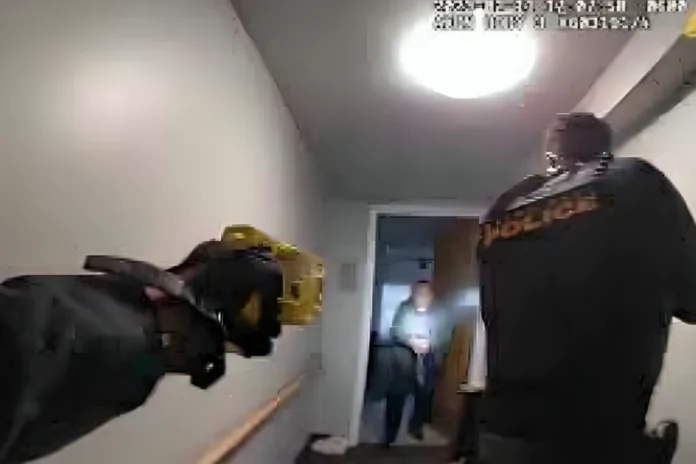
After that, police used pepper spray and Taser in an effort to subdue her. However, when Terrell returned with the knife, one police officer shot twice. She was rushed to Robert Wood Johnson University Hospital, where she was pronounced dead later that morning.
On September 3, 2025, the Attorney General’s Office released body-worn camera video and 911 audio, part of its independent investigation. The footage captures officers attempting to engage Terrell through her closed door, the use of pepper spray and a Taser, and the moments before lethal shots were fired.
Investigators confirmed that officers had been assigned “lethal” and “less-lethal” roles during the encounter, a standard procedure. A 12-inch knife was later recovered at the scene.
The AG’s office has withheld the names of the officers involved, citing reported threats.
Terrell’s family insists the situation could have been handled differently. Her nephew, Tormel Pittman, described the footage as “horrifying,” adding:
“We’re in fight mode.”
Her sister, Linda McCalla, said:
“You call the cops to help, and then there’s a problem.”
Their grief has fueled public anger. There have been demonstrations outside New Brunswick Municipal Court, and on August 20, there was an emotional hearing by the city council. There have been repeated calls by area activists for civilian review boards and stricter police use-of-force restrictions.
Terrell was diagnosed with schizophrenia and recently had her medication re-ordered, said her family. Campaigners note that her case represents long-standing institutional shortcomings.
Since 2015, over 2,000 Americans across the country have been fatally shot by police during mental health crises. Black Americans, like Terrell, are killed at a rate 2.8 times higher than white Americans.
New Jersey has introduced reforms, including the ARRIVE Together program, which pairs officers with mental health professionals, and the Seabrooks-Washington Act, aimed at community-led crisis response. But critics argue both initiatives suffer from funding gaps and uneven implementation.
The Attorney General’s Office of Public Integrity and Accountability is leading the investigation, with findings to be presented to a grand jury, as required by state law. Since 2019, over 100 police-involved deaths in New Jersey have gone before grand juries, but indictments remain rare.
For Terrell’s family and community, her death is not just a personal tragedy but part of a broader pattern. It underscores the pressing question of how law enforcement responds to mental health crises and whether reforms can prevent similar deaths in the future.
As Pittman put it:
“We’re not just grieving. We’re demanding change.”