

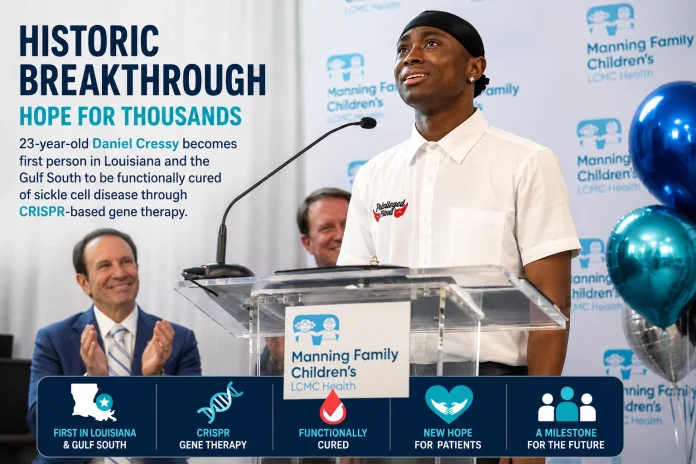
Tears glazed Daniel Cressy’s face as he rang the ceremonial bell at Manning Family Children’s Hospital on June 22, 2026, becoming the first patient in Louisiana and the Gulf South to be functionally cured of sickle cell disease through CRISPR-based gene editing.
“It felt like being reborn,” the 23-year-old from Metairie said. “God has given me another life, a new chapter. I was able to experience a second birthday, something that most people will never experience.”
Surrounded by family, his care team, Governor Jeff Landry, U.S. Rep. Troy Carter and New Orleans Mayor Helena Moreno, Cressy marked 100 days post-chemotherapy — the milestone at which doctors declared his transformed blood system free of the disease.
“What Daniel went through was a pretty painful journey … but he remained faithful,” Moreno said, presenting him with a proclamation honoring the milestone. “You have been given the opportunity to fulfill your dreams, and now you’re giving others hope that they can fulfill theirs, too.”
Cressy joins more than 100 patients nationwide who have been cured with the first two federally approved gene therapies for sickle cell — Casgevy and Lyfgenia. His own two-year journey was delayed while awaiting Louisiana Medicaid approval. Once approved, the process carried a $2.2 million price tag for the therapy alone.
The treatment began in July 2025, when Cressy’s hematopoietic stem cells were harvested over three days and sent to a lab in Scotland. Using CRISPR/Cas9 editing, scientists modified the cells to reactivate production of fetal hemoglobin, preventing red blood cells from sickling. This spring, he underwent intense chemotherapy conditioning before receiving the reinfused edited cells. He spent about five weeks in recovery until his immune system was strong enough for discharge.
“I spent about five weeks recovering from chemotherapy until my immune system was good enough for me to be released back into the public,” Cressy said. The difference has been profound. Where intense exercise once triggered pain or sickness, he recently played kickball without issue. “Now, I was playing kickball the other day and running like crazy, and I felt fine. My body’s sore, but that’s normal.”
Dr. Ben Watkins, a nationally recognized pediatric hematologist-oncologist at Manning Family Children’s and one of Cressy’s physicians, confirmed the success: “Today, his cells are no longer sickling. Today, his hemoglobin is normal for the first time in his life.”
Watkins emphasized the broader significance. While sickle cell disease is the most common inherited blood disorder and almost exclusively affects Black people — with an estimated 3,000 Louisianans living with the condition — research funding has historically lagged and patients have often faced stigma and inadequate care. “Despite its prevalence and severity, sickle cell disease has lived in the shadows,” Watkins said. “Too often, the disease has been stigmatized, and the people living with it have been marginalized.”
Manning Family Children’s is currently the only facility in Louisiana approved to administer the gene therapies. Five additional patients are undergoing treatment, nine more are in the pipeline, and at least 56 have completed consultations.
Diagnosed as an infant, Cressy pursued the therapy to chase his dream of becoming a commercial pilot. In 2022, the FAA denied his medical certification despite four years without a crisis, citing risks at high altitudes. Last year, his friend Kyle Registre became the first known person with sickle cell to earn a pilot’s license after gene therapy in Georgia.
Cressy plans to reapply for FAA medical certification next month and hopes to eventually fly corporate jets, such as those for Gulfstream. “Now the FAA has pretty much no reason to deny me,” he said.
He is channeling his experience into advocacy through the nonprofit Privileged Pilots, which he co-founded with Registre. The organization aims to expand access to advanced gene therapies, support aviation opportunities for those facing medical and socioeconomic barriers, and help others avoid the isolation he endured.
“This entire journey was the hardest thing I’ve done in my life,” Cressy said. “I don’t want anybody else to have to experience the loneliness and the uncertainty and the hopelessness that I felt a couple of years ago. … But overcoming it, now I know that if I can do it, anybody can do it.”
Local artist Terrance Osborne created a painted figure inspired by Cressy — complete with pilot’s wings — now on display at the hospital as a symbol of hope and possibility.
Cressy’s case marks a significant milestone in personalized medicine for the region, transforming not just one life but offering new optimism for thousands living with sickle cell disease.

