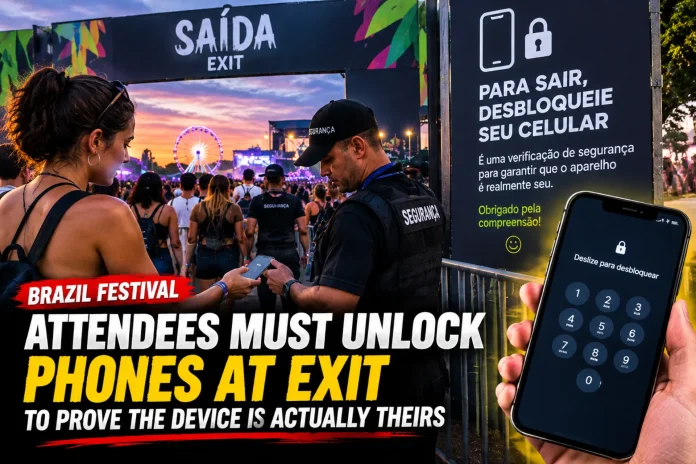
A bizarre new anti-theft tactic at Brazilian events is turning the usual security routine upside down: instead of checking your phone when you enter, some venues are reportedly checking it when you leave.
Festival security in Brazil has reportedly begun asking some attendees to unlock their smartphones before exiting, with the unusual procedure intended to determine whether the device is actually theirs and not one allegedly stolen during the event.
The practice has attracted attention because of how invasive it can feel. Attendees aren’t simply being asked whether they own their phones. In some reported cases, security personnel have required people to demonstrate that they can access the device.
The idea is straightforward: someone who has just stolen a locked smartphone may not know its passcode.
But there’s an obvious problem with that logic. Being able to unlock a phone doesn’t legally prove ownership. A person could know another person’s passcode, while a stolen device could also have been taken while already unlocked.
The Exit Check Isn’t Entirely New
Although the practice has recently resurfaced in reports about Brazilian festivals, a strikingly similar incident was documented in Belo Horizonte in January 2024.
According to Estado de Minas, attendees leaving the Bloco do Silva event were searched and asked to show their phones in an unlocked state. The report said people who refused were prevented from leaving at that point.
The incident immediately raised questions about how far private event security can go when checking attendees and their personal devices.
A criminal lawyer quoted by Estado de Minas questioned the legality of inspecting someone’s phone without consent, highlighting the enormous amount of private information stored on modern smartphones.
And this wasn’t described as a universal Brazilian festival rule.
The same report noted that organizers of Festival Sensacional said they did not use the same type of exit inspection. An association representing event producers also indicated that the procedure was not something it commonly encountered.
Why Are Festivals Doing This?
The answer is simple: cellphone theft is a serious problem at large events.
Crowded concerts and festivals create ideal conditions for thieves. Thousands of people are packed together, many holding expensive smartphones, while music, movement and crowds can make it difficult for victims to notice when their devices disappear.
The problem can become even more serious when thieves operate in organized groups and steal multiple phones during a single event.
Brazil has responded with broader anti-phone-theft measures as well.
The federal government’s Celular Seguro program allows people to report stolen or lost phones and activate blocking measures intended to make the devices, mobile lines and participating financial applications harder to exploit.
Reports surrounding major Brazilian festivals have also continued to document arrests and investigations involving groups allegedly targeting attendees’ phones.
Legal experts say private security can request the unlock as part of keeping the venue safe, but they can’t force anyone or turn the process into a confrontation. The check is supposed to be applied evenly, without targeting people based on how they look.
Similar exit checks have shown up at parties in Rio, Belo Horizonte, and even some clubs in Argentina. For fans, it can feel like one more hoop to jump through after a long night of dancing. For organizers, it’s another tool in a growing list of attempts to keep people from walking out with someone else’s phone.
In a country where big festivals remain a central part of the music culture, the reverse search is becoming one more sign of how seriously promoters are taking the theft problem — even if it means asking you to unlock your screen on the way home.